
On biting and bullets
Humans, like other animals, react to pain reflexively. The usual example is that if you touch something that is painfully hot, you will remove your hand from it before you consciously register what’s happening.
Humans have a lot of instinctive but non-reflexive reactions to pain as well, such as applying pressure to wounds. These are not automatic but rather driven by strong physical urges. When experiencing extreme pain, these urges (such as the urge to apply pressure or the urge to scream) can be overwhelming. At that point, the reaction is basically automatic.
This became relevant to a lot of people as surgery advanced faster than anesthetics. Even with early anesthetics like alcohol, opium, and ether, these were often not available in situations such as war and were never completely safe and effective. The advent of modern warfare, particularly the use of larger armies, projectile weapons, and explosives, led to unprecedented numbers of wounded. Moreover, many of these individuals survived injuries (that previously would have been mortal) thanks to surgery.
Which is not to say that such people were always thankful for surgery, and vast numbers of people underwent surgery and died anyway. Surgery was still more akin to skilled butchery (in the best of cases) than to modern medical practice.
In the United States, this legacy is a fundamental part of what made the American Civil War what it was. Many battles were bloodbaths and the pain and suffering of the injured and dying is legendary. We have the almost mythological image of Civil War field hospitals where wounded soldiers would have limbs hacked off without anesthetic.
When humans experience pain, aggression, or fear, one instinctive reaction is to clench one’s teeth. This has the practical purpose of preventing injury to the jaw, teeth, and mouth, similar to mouthguards in sports. It seems to me also that other urges, like the urge to scream, can be sort of redirected to tensing a muscle (e.g. clenching teeth or fists).
However, clenching one’s teeth too tightly can cause injury. Humans have long known that a better option is to bite down on something like a stick. This allows the jaw muscles to be kept very tense without putting such acute forces on the teeth. Holding the jaw slightly open might also part of the advantage.
So when it came to surgery without anesthetic, as with other situations where humans know they are going to experience intense pain, an obvious choice is to bite down on something. Ideally, the object should be hard enough that it absolutely will not get crushed by the teeth, while also being soft enough to prevent teeth from breaking. I mentioned sticks earlier, but another option is a ball of lead, which despite being highly poisonous has the desired physical properties. These were also readily available to soldiers at the time.
If you were a Civil War soldier with an injured leg, your only options might be dying of gangrene or biting a bullet and having your leg painfully amputated.
Hence the idiom “biting the bullet” refers to going through with an unpleasant experience with the idea that the net benefit will be worthwhile or it’s just something you have to do.
Philosophical bullet-biting
In philosophy, the phrase is used to describe accepting an idea you otherwise wouldn’t because it’s a consequence of a belief you’re not willing to give up.
For example, a person who believes strongly in determinism might “bite the bullet” in accepting that free will doesn’t exist. This is sort of a counterpart to another line of reasoning, reductio ad absurdum (often just called reductio). This is “reducing to absurdity,” meaning deducing a logical contradiction as a consequence of a proposition (aka “denying the consequent” or modus tollens). This doesn’t have to be a self-contained contradiction, i.e. it could contradict a different proposition which is held to be true.
So here’s how someone’s reasoning might go regarding consequences of a certain philosophical position. Suppose a person is convinced of propositions P and Q and is considering another proposition R. They are presented with two convincing arguments, first that R follows from Q, and second that R contradicts P.
They have two options. If the person is more convinced of P than of Q, then they can treat this situation as denying the consequent of the argument from Q. On the other hand, if they are more convinced of Q than of P, then they can “bite the bullet” by giving up P.
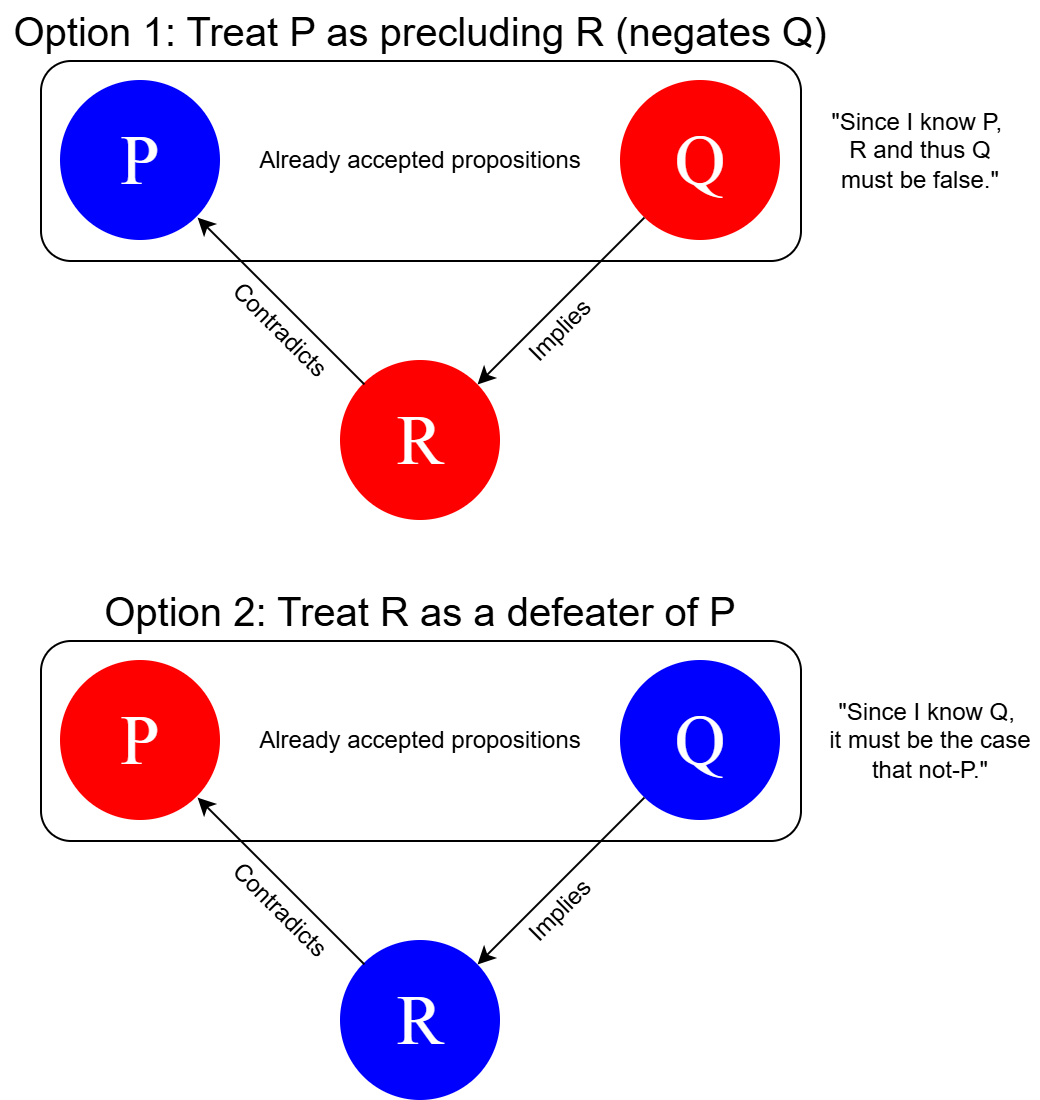
Option 2 (bottom): Biting the bullet by accepting R and rejecting P.
For example, suppose that someone believes both that the earth is flat and that the shortest path between two points on the earth is an arc of a circle. This person could be shown a proof that the shortest path being an arc must mean the earth isn’t flat. They would then have a choice: bite the bullet and take the proof as a defeater of the flat earth, or maintain their belief in the flat earth and revise their belief about the shortest path.
You might notice that, logically, there’s not much difference between these two options. It’s really a matter of being convinced of multiple contradictory things, and having to resolve that by accepting that a belief you were previously convinced of isn’t true. The difference is in how a proposition is characterized as new information or old information. Reductio typically denies new information, while biting the bullet involves contradicting old information.
It’s just an informal term, of course. It’s generally used not just when a deeply held belief is being contradicted, but more specifically when the result is highly counterintuitive, when the contradicted belief has a compelling pragmatic purpose, or when the result is seen as having undesirable consequences (such as implicitly endorsing antisocial behavior). It’s also a term that is used mostly by detractors to an argument for obvious reasons. This is a purely rhetorical move, something along the lines of, “If you want to bite that bullet, be my guest…” It’s emphasizing the “downsides” of adopting a certain position.
My distaste for bullets
The phrase is relevant to me because my philosophical views have often been accused of requiring significant bullet-biting. It’s not a logical argument against my position, it’s merely an observation that the speaker disagrees with me.
For example, I believe the shortest path between two points on the earth is the arc of a circle. I do not believe the earth is flat. If I presented a flat earther with my belief about the shortest path, and showed them the proof that this would imply the earth is not flat, they would certainly refuse to bite the bullet and admit that the earth is a spheroid.
But I’m not biting a bullet by rejecting the flat earth, and that’s the point I want to make.
I’m not committed to the shape of the earth at all, rather the spheroid earth is a conclusion I hold to be true based on the information I have available.
To give a more realistic example, I don’t believe people are objectively morally responsible for their actions. I wrote about this in more detail in another post. This view comes across as genuinely deranged to many people, and in particular what they are concerned about is the perceived consequences of this view.
The worry, or the reason one would have to bite the bullet, is that our social and judicial practices of punishment and atonement can’t be morally justified if people aren’t morally culpable. This is true, but I don’t additionally hold that these practices require this kind of moral justification. Nor is it possible, in my opinion, to have such a justification in any case.
In other words, biting the bullet is something that happens because of one’s other beliefs, it’s not inherent to the proposition in question. It fails (even rhetorically) when directed at someone who has different beliefs in general. It only works rhetorically, and only on someone who already agrees.
To me, this makes the phrase fundamentally dogmatic. It serves only to reinforce beliefs that people already agree with. It has no logical force and will always be unconvincing to someone who has different beliefs. The narrow edge case where it is genuinely useful is when the person proposing the new idea has not thought through the logical consequences of that idea. However, I think it is unwise to ever assume that a person has not thought through the consequences. It is always more likely they simply disagree on more points than that one.
Image: “Amputation” by Thomas Rowlandson, 1793

