
0.999… repeating (or ) is equal to 1.
It’s a fact. To some, this is highly counterintuitive, unbelievable even. I’ve seen various explanations for how it works, from informal explanations to formal proofs. I recently found an interesting (not original) proof, but first I’ll give a couple less rigorous explanations.
Informal arguments
Tripling a third
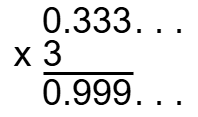
Observe that ⅓ = 0.333… repeating. If we multiply ⅓ by 3, we know we will get 1. Let’s think about multiplying the decimal.
Most people are familiar with the standard column multiplication algorithm, and while it doesn’t quite work in this infinite case, we can use it informally.
In this algorithm, we multiply each digit of the first number by each digit of the second number. Since we are multiplying each digit of 0.333… by 3, each digit should become 9, yielding 0.999…
Since ⅓ is the same as 0.333.., multiplying each of these by 3 must be the same number, meaning 1 = 0.999…
Nine ninths
Observe that whole numbers 0-8 exhibit a pattern when divided by 9:
0/9 = 0.000…
1/9 = 0.111…
2/9 = 0.222…
3/9 = 0.333…
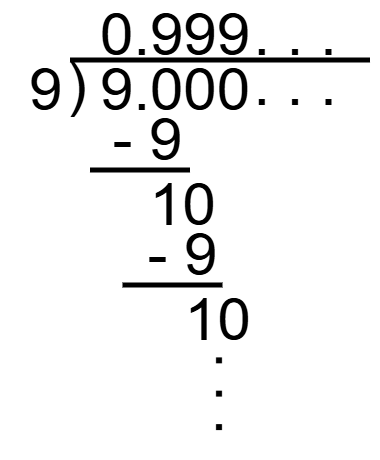
And so on. The fraction 9/9 equals 1, and by this pattern it should be the same as 0.999… We can actually get this result by doing long division slightly wrong.
If we divide 9 by 9, we should just get 1 since 9 goes into 9 one time. Instead, let’s think about doing 9 into 9.0. We’ll say 9 goes into 90 just 9 times, giving us a remainder of 1. If we keep going, we’ll keep getting nines forever.
Proof: decimals as series
Our goal is to directly show that the decimal representation 0.999… is equal to 1. Let’s think more formally about how a string of decimal digits represents a number.
The sequence of digits “456.78” represents:
More generally, we get the value of a decimal number by multiplying each digit by a power of 10 based on its place value and adding these up.
The infinite sum representation
Observe that the decimal 0.999… represents:
We can represent this infinite sum as follows.
Let’s focus on the sum itself. We’ll put the 9 back later.
By rewriting the index we can see it in the more familiar form of a geometric series. The idea here is that if the index started at 0 instead of 1, we would be adding an additional term that equals 1:
That would give us 1.111… instead of our desired 0.111…., and that’s ten times too much. We solve the problem by dividing every term by 10.
We now have it in the standard geometric series form of:
The first term a and growth factor r are both 1/10. We can use the formula for geometric series to evaluate:
Finally, we have:
QED.
Concluding remarks
Infinitely repeating decimals are an artifact of our place value numeral system. Which rational numbers terminate and which go on forever depends on our choice of base. For example, in base 10, 1/5 terminates but 1/3 doesn’t. In base 9, the opposite is true.
It’s tempting to think that 0.999… should represent some amount infinitesimally less than 1, but the fact that the digits go on forever implies there actually is no such missing part. The confusion ultimately comes from contradictory intuitions about what decimal numerals mean, but when we apply the definitions carefully there’s no issue.
Photo by Laurel Hechanova (CC-BY)
See also:
Stories of math notation (part 1): y should come before x
Stories of math notation (part 2): The worst notation in mathematics
 thoughts on mind