
How can we tell that something is likely true?
How we know stuff
A proposition is a type of statement that can be true or false. Not all sentences are propositions. For example, “Some parrots have green feathers” is a proposition, while “Colorless green ideas sleep furiously” is not a proposition.
There are essentially three ways of determining whether a proposition is true, false, likely true, or likely false. These are logic (rational), observation (empirical), and intuition.
Virtually any two people could reason about something the same way or observe the same thing. On the other hand, each person’s intuition is different, and at the moment we can’t really evaluate exactly how intuition works. It has to do with neural pathways that operate unconsciously, but the details of what’s happening in any individual’s brain is generally unknown.
As a result, intuition is an inherently subjective tool. Reasoning and observation can be agreed upon by virtually anyone, which is the closest to objectivity that humans can get. Things that are agreed upon like this are sometimes called intersubjective.
In science, intuition is used for things like coming up with hypotheses and designing experiments, but it can’t be used to justify scientific claims. Something that is intuitively thought to be true must be tested rationally and empirically. This is because many facts are unintuitive or even counterintuitive.
Confirmation, falsification, and corroboration
Propositions differ in how they can be investigated. Some propositions can be confirmed, in other words directly verified by evidence. For example, “The sky is blue” can be confirmed by observing that the sky is blue. Some propositions can be falsified, or directly contradicted by evidence. So “The sky is magenta” can be falsified by observing that the sky is blue and not magenta. Finally, some propositions can be corroborated, which is when a proposition fails to be falsified by evidence.
Let’s put a pin in corroboration, since it’s more complex than the other two. It’s important to note that these categories are not mutually exclusive, for example the proposition that the sky is blue can be confirmed, falsified, or corroborated.
Confirmation is what we would like to have, but it often isn’t possible. Scientific claims such as physical laws cannot be confirmed, because they say something about an unknown future. This is the problem of induction: just because a pattern has held up till now is no guarantee the pattern will continue indefinitely into the future.
Philosopher of science Karl Popper famously established falsification as the gold standard in science. Scientific claims don’t need to be confirmable, but they must be falsifiable. The way claims (hypotheses) are tested are by attempting to falsify them. Every attempt that fails counts as corroboration, and the more highly corroborated a hypothesis is the more likely it is to be true.
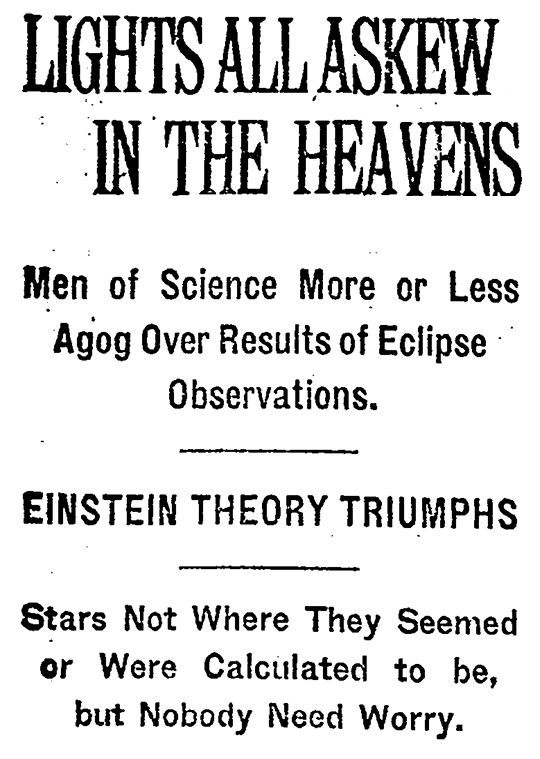
Take Newton’s Law of Universal Gravitation for example, which states that the force of gravity between two massive objects varies directly as the masses and inversely as the square of the distance between them: . For a long time, all our observations corroborated this law. However, in 1919 an observation of stars behind the sun during a solar eclipse established that light bends around massive objects, falsifying Newton and corroborating Einstein’s new theory of relativistic gravitation.
Falsifiability and unfalsifiability
A proposition is unfalsifiable if there is no possible way any observation could falsify it. For example, I could make the claim that there is an invisible, immaterial unicorn in my living room. Because there is no observable difference between the unicorn being there and the unicorn not being there, the claim is unfalsifiable.
Popper distinguished pseudoscience as that which appears to make scientific claims except that the claims are unfalsifiable. For example, most astrology is unfalsifiable. This is because predictions are vague and open to interpretation. However, not everything unfalsifiable is pseudoscience.
The claim that God exists is unfalsifiable, for example, as is the claim that falsification is the best way to reach correct conclusions. Notably, it is not wise to regard all unfalsifiable propositions as false. Rather, they are things that simply cannot be assessed by science. Unfalsifiable beliefs are sometimes problematic, sometimes beneficial, and often have no significant impact either way.
Falsifiability and corroboration
Corroboration is not simply any observation which fails to falsify the claim in question. For example, an observation that my cat has green eyes neither corroborates nor falsifies the claim that the sky is blue.
For an observation to corroborate a claim, that observation must be capable of falsifying that claim. Since observing the color of my cat’s eyes can never falsify the sky being blue, it cannot corroborate it either.
In particular, nothing can corroborate a claim that is unfalsifiable, because no observation would ever falsify the claim. This is a significant point because of a certain line of fallacious reasoning people sometimes fall into.
False corroboration
People who want to convince others of unfalsifiable claims, such as Christian apologists and pseudoscientists, often try to appeal to corroboration. For example, historical evidence suggests that some direct followers of Jesus believed he had been resurrected. Some apologists want to say that the very existence of this belief corroborates the claim that Jesus was in fact resurrected.
The problem with this line of reasoning is that the absence of this evidence would not falsify the claim that Jesus was resurrected. There is no evidence that would falsify the belief that Jesus was resurrected, because Jesus’ permanent death can only ever be corroborated.
For example, suppose that tomorrow archaeologists discover a tomb in Israel containing an adult male body that had been crucified, the tomb can be dated to 30-40 CE, it was never disturbed since then, and an inscription labels the body as Jesus of Nazareth. This would be corroborating evidence for the permanent death of Jesus, because the observations (had they been different) could have falsified the claim that this body was Jesus. If the tomb dated to 100 BCE, or the body was a young child, etc., it could be established that the tomb was not Jesus’ final resting place.
There are literally millions of graves and tombs that can be established not to be Jesus’. On the other hand, it is possible that the hypothetical tomb which appears to be Jesus’ is not in fact his. Maybe the day after Jesus’ death another Jewish man was crucified, and for some reason someone decided to place the body in this tomb and mislabel the body as that of Jesus.
And of course, if the body is possibly not Jesus’, then we cannot use it to prove that Jesus died and was not resurrected.
This type of false corroboration is often used by anyone trying to defend an unfalsifiable claim. A proponent of astrology might say that their horoscope told them something unexpected would happen that day, and on that day they were unexpectedly splashed with water by a passing car. It doesn’t work; not having been splashed by the car would not falsify the claim, so being splashed by the car cannot corroborate it. The claim is too vague.
A final point
It is not fallacious to believe something unfalsifiable. In particular, holding unfalsifiable religious beliefs is not inherently fallacious. The problem arises when trying to point to external justifications. Beliefs that are based on faith or intuition should be taken on that basis, and one should not attempt to provide evidence; it is futile.
It’s difficult, of course, to convince others of your intuitive or faith-based belief, because of its subjective nature. Many people want to be able to make an argument and point to evidence in order to convince others, and this is often convincing to some, but it’s also fallacious.
Photo by Aubrey Gemignani/NASA
 thoughts on mind