
Color is a visual phenomenon. Some would say that the essence of color is the qualia of seeing color (see Mary the color scientist). Qualia or no, it’s incorrect to make a direct association between color perception and the wavelength or frequency of light.
They are related, of course. A source that produces monochromatic light with a wavelength of 580 nanometers will appear yellow to a person with normal color vision. Most of the light we see, however, is not monochromatic; it’s a mixture.
It’s well known that white is not a color of light, but rather a mixture of all visible wavelengths. This can be revealed by passing the light through a prism, which refracts different wavelengths at different angles, splitting a white beam into a rainbow.
Less well known or appreciated is the fact that light of almost any color can be a mixture, and also that white light need not contain every visible wavelength. This is something virtually everyone has an underlying understanding of, even if they don’t realize these generalizations.
It comes down to the idea of mixing primary colors to produce new colors. Color mixing can be additive or subtractive, which loosely corresponds to mixing light vs. mixing pigment respectively. In printing, we use the primary colors cyan, yellow, and magenta (plus black to produce darker shades). Each primary pigment absorbs the light reflected by the other two (hence subtractive). This scheme is often described as CMYK for cyan, magenta, yellow, and black (key). White is only achieved through printing no pigment onto a white surface.
The additive primary colors are red, green, and blue (RGB). If you shine a red light and a blue light at the same spot on a white wall, the wall will appear magenta. In this case black is achieved through producing no light at all and white is achieved through mixing all three primary colors.

So if you have magenta light and a prism, you could tell that it is actually a mixture of red and blue light. In the case of magenta, it can only be produced in this fashion. It is unique as a color in that there is no wavelength of monochromatic light that appears magenta. In essence, magenta is the brain’s way of turning a one-dimensional spectrum into a color wheel. Red and violet are at opposite ends of the visible light spectrum, and magenta is the “imaginary” color that goes in between them.
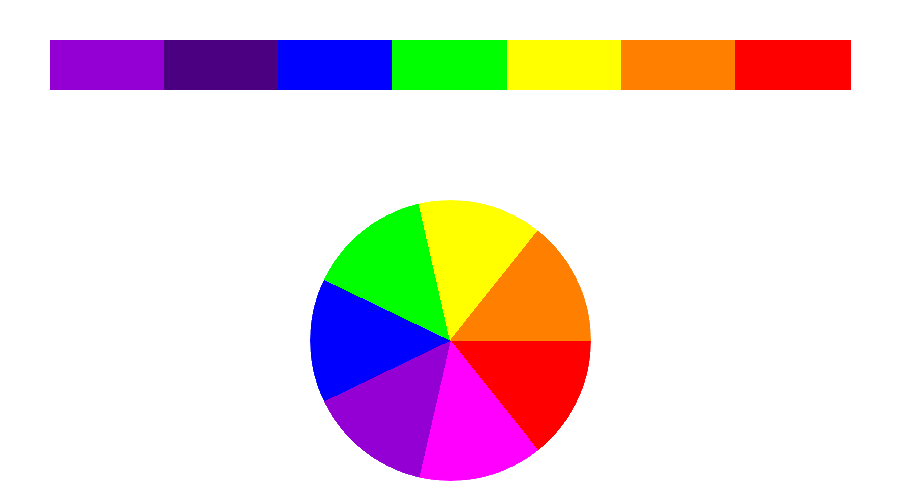
This effect isn’t limited to magenta, however. Mixing red light and green light produces light that appears to be yellow, even though it is not yellow light in the sense of having a wavelength in the yellow range. For example, if you have a three-bulb RGB projector that is shining on a white wall and the wall appears to be yellow, a prism could reveal that it is actually a mixture of red and green.
This is something most people see every day. Whenever you look at a screen, whether CRT, LCD, or LED, you are only seeing red, green, and blue light. It is the fact that these are mixing in particular ways that produce all the colors we visually see.

What is color– really?
I’ve heard it said that magenta is not a real color since there is no wavelength of light that is magenta. I’ve similarly heard that the color yellow as seen on your computer or phone screen is not really the color yellow, because no yellow-wavelength light is being produced. Is this an accurate way to talk about color?
In my opinion, no. The word “color” is being used to refer to two different concepts here, and they’re being inappropriately conflated. Because light of a single wavelength is a specific color, it’s natural to describe that wavelength as being that color. That doesn’t mean that is the only way that color can be instantiated.
I maintain that magenta or “computer screen yellow” are not illusions but rather normal color perception working correctly. This is based partly on an important biological fact: human vision cannot distinguish between monochromatic yellow light and yellow that is produced from a mixture of red and green light. It is not physically possible to do so.
You may question this assertion. After all, if you look closely enough at “yellow” pixels (at sufficiently low resolution), your eyes will be able to resolve separate red and green lines. However, this is because the light is no longer mixed at that point. The red light and green light aren’t hitting the same part of your retina like they are when you sit back from your screen.
The reason for the inability to distinguish a mixture is the mechanism of color perception within the eye. Humans with normal color vision have multiple types of photoreceptive cells covering the retina, namely rods and three different types of cones. Rods are primarily for detecting light and darkness and help with low-light vision. The three types of cones are often called either long, medium, and short (referring to wavelength ranges) or red, green, and blue (referring to the approximate colors of the represented wavelengths).
The range of wavelengths detected by each type of cone cell overlap, with only the extremes of visible color being covered by just one type. Whenever light enters the eye, it can potentially stimulate all three types of cones, and often does. Importantly, it stimulates them by different amounts.

Color perception works by the brain interpreting the relative strengths of different types of photoreceptors. Light with a wavelength of 475 nanometers stimulates blue cones a lot, green cones just a little, and red cones even less: a slightly greenish blue.
Now consider what happens when a mixture of light enters the eye. Let’s say it’s a mixture of 425 nm light at a high intensity and 550 nm light at a lower intensity. Now, blue cones are stimulated a lot, green cones are stimulated a little, and red even less: the same greenish-blue.
Note that color perception isn’t a snapshot, it’s an ongoing process. The retina requires many, many photons over a period of time to create a clear signal to the brain. So the two situations described above are completely indistinguishable; what the brain receives is just the information about how strongly the different cone cells are being stimulated.
If the color signal to the brain is identical, I say that is genuinely perceiving the same color. Because color is perceptual, the same perception is the same color.
What does it mean?
There exists linguistic confusion because of the co-opting of the word “color” in physics. It is not too dissimilar to the use of the word “light” in physics. “Light” almost always refers to visible light, but it can refer to any wavelength of electromagnetic radiation. In the same way, “color” almost always refers to color perception, but it can refer to any specific wavelength of electromagnetic radiation. So a 100 MHz radio signal (electromagnetic radiation with a wavelength of about 3 meters) is “light” with a specific “color”.
But it’s strange to talk about radio waves or other invisible electromagnetic radiation as being colored light. Light, as we normally understand it, visibly illuminates. And color, as we normally understand it, is also part of visual perception.
When infrared and ultraviolet radiation were discovered, it was natural to label these as invisible forms of light. Indeed, we now know that some animals can perceive these wavelengths as colors of visible light. The concept was overgeneralized as more “invisible light” was discovered, like X-rays and radio waves.
But wait, there’s more
All of this is not to mention the additional complications of contextual color perception. Under colored light, we can detect the “actual color” (i.e. what the object would look like under white light) by making unconscious inferences.
For example, if two objects are side-by-side under yellow light, and you already know what one of them looks like under white light, then your brain will automatically infer the appearance of the other object. This can cause perceptual errors when the context isn’t sufficient to determine the lighting conditions.
This was very notably brought to many people’s attention with the dress.
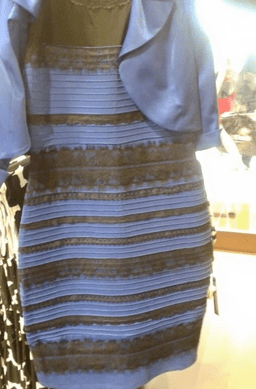
Due to unclear lighting conditions, the garment appears to some to be blue and black while others perceive it to be white and gold. When seen in person under normal conditions, the dress appears blue and black.
Rarely does one come across such a stark example, but such misperception is common and usually inconsequential. What does that mean for color, though?
This may be a matter of opinion, but I think the people who saw the dress differently saw the same colors and interpreted what they were seeing differently. I go back to the information sent to the brain as the standard, and in this situation peoples’ brains were receiving the same input.
I think a reasonable argument could be made that people genuinely do see different colors, but I disagree. In part, it’s because this “level” of color perception isn’t something we can easily measure and describe at present. Maybe more significantly, while the white-and-goldness of the dress is a perceptual reality for the people who see it, we can generally agree that this is a misperception of color.
On the other hand, I would say color blind people do genuinely see different colors, for the same reasons.
Photo by Sanketh Rao
 thoughts on mind