
Suppose you have a collection of pairs of shoes and pairs of matching socks. Let’s think about two questions:
Can you create a set containing one shoe from each pair?
The answer is yes, for example you could take the left shoe from each pair.
Can you create a set containing one sock from each pair?
The answer is again yes, but this time there’s no way to distinguish between the two socks in a pair. Instead, you would go through the pairs one-by-one and arbitrarily choose one sock from each.
This process of forming a set from one out of each pair makes a function from the set of pairs to the set of individuals. In the case of shoes, we have a function rule that tells how to get each individual from its pair (namely, take the left shoe).
For socks, we can’t make a rule because the two socks in a pair are indistinguishable. Instead, we get an arbitrary function. Sometimes this type of function is called “random” because it chooses individuals “randomly”.
It may seem obvious at this point that it is mathematically possible to construct an arbitrary function. I can actually construct an arbitrary function with real life socks, so it has to be mathematically possible. More generally, from our thought experiment we can conclude that a finite arbitrary function will work.
The infinite case
This time you have infinitely many pairs of shoes and socks. If you try to do the same thing as before, we see that the function rule for shoes still works. The set of all the left shoes is also infinite, but it is just as well-defined as the set of shoes. If I ask you which shoe from pair n is in the set of left shoes, you can tell me “without looking” that it’s the left shoe.
Things get more difficult when trying to construct an arbitrary function to get socks from their pairs. In fact, it is not possible to construct the entire function. At any given time, you can only be certain of finitely many specific socks that go in the set of singles. If I ask you which sock from pair n is in the set of single socks, you can’t tell me “without looking” which one it is, since the socks are the same.
The sock which belongs to the set has no distinguishing characteristics by which you could describe it in contrast to its partner. All you can do is go to the pair and show me which sock it is.
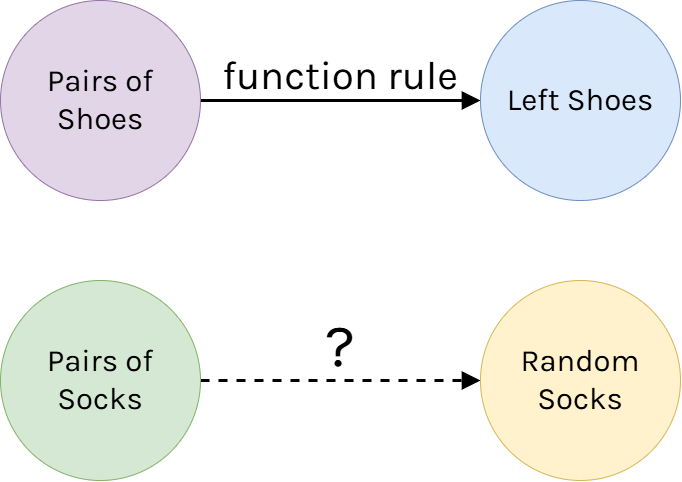
More generally, infinite arbitrary functions can’t be constructed in their entirety. It’s unclear if they genuinely exist and if we can reason about them in their entirety without really knowing anything about their behavior. It sure would be nice if we could, though. There is a lot of mathematics that cannot* be solved due to this problem.
*Enter the Axiom of Choice
The Axiom of Choice, abbreviated Choice or C, is an axiom of set theory. Axioms are the basic principles which define what a theory is. For example, the axioms of arithmetic include that adding zero to any number yields the original number.
The Axiom of Choice says that you can create an infinite arbitrary function. The choice here is in reference to choosing elements arbitrarily (like socks). It’s not constructive; it doesn’t offer a way to create such a function. Instead, it just says you can do it… just by saying you did it.
Is this a reasonable axiom to adopt? On one hand, denying mathematicians the ability to use arbitrary functions seems unnecessarily restrictive when we know we can do math with them. On the other hand, it seems questionable to sidestep the inherent difficulty by saying, “we don’t know how or why, but we’re allowed to do this.”
Choice has some questionable consequences as well, such as the Banach-Tarski Paradox. Here a hollow ball can be cut up and the pieces rearranged to form two balls, each the exact same size as the original.
Some mathematicians and philosophers of mathematics believe the axiom is actually false. However, the situation is more complex than simple true or false.

There are multiple alternative set theories with different axioms, but the one most used in modern mathematics is based on the Zermelo-Fraenkel (ZF) theory. The Axiom of Choice is not part of ZF, and is in fact logically independent of the axioms of ZF.
This means that ZF plus the Axiom of Choice (ZFC) is consistent and you can prove theorems in it, and ZF plus the negation of the Axiom of Choice (ZF~C) is also consistent, and you can prove different theorems in it (as well as many of the same theorems). In plain ZF, the Axiom of Choice is undecidable.
The unanswerable question
Is the Axiom of Choice true?
It’s undecidable in set theories that are similar to ZF. In ZFC, the version that most mathematicians use, it’s assumed to be true as an axiom. In these cases, though, we mean “true” in a formal theory. That’s not the same thing as what people normally mean by “true”.
Philosophers of mathematics disagree about whether mathematical truth has any meaning beyond true-in-a-theory. The facts of arithmetic seem genuinely true for example, and most agree that the formal theory of arithmetic accurately captures this truth. A non-standard arithmetic may make for a consistent formal theory, but it doesn’t seem to be true in the same way. Two of the major opposing perspectives on mathematical truth are Platonism and formalism.
For Platonists, mathematical objects exist in a realm of abstract ideal forms and there are brute facts about what those objects are like. In this view, math is “out there” to be discovered. If sets are real things, then there is a fact of the matter as to whether the set of infinitely many arbitrarily chosen socks exists. In other words, the Axiom of Choice is either true or false. In my experience, Platonists are the most likely to reject Choice.
Formalism the view that mathematics is the exploration of logical consequences of formal statements. This allows for a greater pluralism towards theories. ZFC and ZF~C are seen as different, equally valid formal systems. Instead of focusing on whether a theory is actually true, formalists prioritize usefulness and interestingness. Having Choice is more useful and interesting than not having Choice, so adopting the axiom is generally preferred by this perspective, though this isn’t the same as asserting it’s true.
Final thoughts
The Axiom of Choice is an interesting proposition because we understand the meaning very well (it has been extensively studied), and it seems on its face like something that would be true or false, but it’s mathematically impossible to say for sure if it is “actually true” or “actually false”. Moreover, while the axiom is useful in a great number of proofs, it also proves things that seem like they should be false (notably the Banach-Tarski paradox).
It’s kind of a fun thing to have an opinion about because it will never have an answer. It’s more like having a favorite color than a propositional belief. People who philosophically reject Choice can nevertheless use it to prove theorems, and people who accept the axiom can of course work in formal theories that don’t include it. Most mathematicians unsurprisingly don’t have strong feelings one way or the other about it, and many reject the idea that the Axiom of Choice could be true or false.
But you get to have an opinion on it if you want to, and it doesn’t matter what your opinion is. Do you think it’s possible to pick infinitely many random socks from infinitely many matching pairs?
“The Axiom of Choice is obviously true, the well–ordering principle is obviously false, and who can say about Zorn’s Lemma?”
-Jerry L. Bona, on the Axiom of Choice and two statements that are logically equivalent to the Axiom of Choice
Photo by kaboompics.com
 thoughts on mind