
I’m not a prescriptivist, I swear.
As someone who is math-oriented (and maybe has some neurodivergent features), I like formal rules. I enjoy treating English grammar like a math problem; and, due to the circumstances of my upbringing, I am highly proficient at “standard” English. When I was younger I understood this to be a single set of rules, but my approach now is to follow an appropriate style guide for the situation. Except when writing this blog: I often challenge myself to write more freely than I normally would, for example by knowingly violating standard rules. At the same time, I sometimes feel compelled to continue to follow rules I disagree with. One such rule is placing periods and commas inside quotation marks.
When a quote is at the end of a clause or sentence, it would naturally be followed by a comma or period. In the US, the rule is to place the punctuation inside the quotation marks, “like this,” rather than “like this”.
This rule has always bothered me. It doesn’t look right and doesn’t feel right to me. It was only fairly recently that I looked up where this rule came from. Now, many grammatical rules exist for silly or even arbitrary reasons, but most of the rules themselves are inoffensive to me so I don’t care why they’re there. In this case, I wanted a good reason to do something so contrary to my linguistic intuition, and I don’t feel that I got one.
It’s only for aesthetics. The idea is that a double quotation mark followed by a comma creates an awkward gap. There’s actually the same amount of empty space in both configurations, but placing the comma inside consolidates the area beneath the quotation mark with the space before the next word.
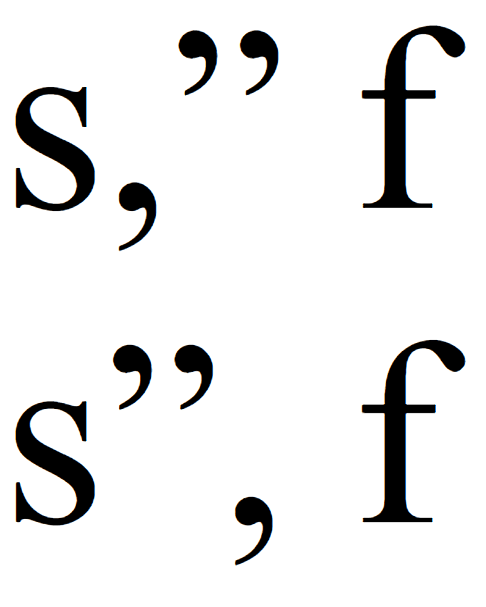
Doing something for aesthetic reasons isn’t at all objectionable on its own. Like I said, there are much worse reasons for some rules. The question is, does it justify interfering with quotations like this? The MLA defends the practice:
It’s true that the convention followed in the United States treats the comma or period as if it were part of the quoted material. But the practice is “not likely to give a false meaning to the words cited” (Wilson 114). Indeed, this sleight of hand involving punctuation is minor compared with the violence of quotation itself: quoting almost always entails wrenching the original author’s words out of their context, an action that inevitably affects their meaning.
Eric Wirth, mla.org (2016)
In my opinion, this argument doesn’t work. I don’t think the positioning of punctuation adjacent to a quotation mark is comparable to the act of quoting. Literally the only way to extract a portion of a text for inclusion in another text is by removing it from its context. While it’s true this can dramatically change the meaning of a passage, and while the punctuation issue is a minor concern with respect to changing the meaning, my view is that these are apples and oranges. Additionally, the possibility of “giving false meaning to the words cited” is not really my biggest problem with this practice. It’s more that it feels inappropriate and unnecessary.
It’s true that if a convention is widely followed then it is unlikely to cause confusion. But this would be true of virtually any convention, and thus can’t justify or support any particular one. It just means that writing conventions are not a big deal so long as they are not too unwieldy. That is not a good reason to follow arbitrary harmless conventions (as doing things more simply is almost always preferable to having additional rules), much less any convention that has some kind of downside.
What about the aesthetic merits? I do understand that the period or comma on the outside looks a bit clunky. However, I’ve noticed that with text as small as what we usually read, the difference is pretty insignificant. What I would propose is a more flexible rule, where it is at the writer’s discretion to position the period or comma appropriately for the situation. In certain cases either positioning can look wrong.
So, that is what I have decided to do as sole arbiter of the style on this blog. Granted, applying conventions inconsistently is almost always worse than consistently following any one convention. Let’s not forget, however, that many aspects of writing simply have no convention associated with them at all (being completely at the discretion of the writer). For example, I could have started the previous sentence with “However, let’s not forget that…” In the following sentence, I could have put “for example” at the end instead of the beginning.
This is more of an exercise in self-growth than it is a stylistic or grammatical issue. In my life I have primarily written just one way, in this sort of semiformal essay format. A major reason for that is because I learned, as I understood it at the time, the “proper” way to write, and still have a strong inclination to follow those rules. This blog is by far my biggest writing project, and I am gradually becoming more comfortable with being flexible about how I use language. Previously, I never would have ended a sentence with a preposition or started a sentence with a conjunction. I recognize now that the way most people normally speak English doesn’t really follow these rules. I now use these structures freely on my blog. And even sentence fragments, sometimes.
In case it isn’t clear, this post is not writing advice. I’m just trying to write in a voice that is authentic to how I want to express myself.
Photo by Markus Spiske
 thoughts on mind