
“What counts as art” is such a perennial question in philosophy that it has been practically beaten into the ground by now. What else is there to say? The topic has been given new life by generative AI and other technological phenomena, but fundamentally the arguments are the same as they’ve ever been. My own views on the matter are a little unusual.
The definition of art is controversial in contemporary philosophy. Whether art can be defined has also been a matter of controversy. The philosophical usefulness of a definition of art has also been debated.
Stanford Encyclopedia of Philosophy

I’ll lay my cards on the table right away: I don’t think “art” exists, at least not as a single concept. See the SEP article’s section on skepticism. My personal opinion is roughly as follows:
- As a mereological nihilist, I don’t even think individual works of art “really” exist, so “art” cannot be formally a concept whose extension is the set of all works of art, since such a concept would have no instantiation in the world.
- At best, art is a social construction, but there is no actual intersubjective construction, only the individual constructions in individual people’s heads.
- Designating something as art is therefore a matter of personal cultural opinion governed by socially ingrained principles.
This is always a dangerous word to use, but I think art is obviously a matter of opinion when looked at the right way. “The right way” here is maybe something like physicalism (aka materialism) and naturalism, but I want to focus on my personal perspective of nihilism. (Note that I’m not saying I think the way I see things is the right way, but rather I subscribe to a philosophical perspective that is in my opinion the “right way” i.e. most truthful of looking at things.) This philosophical perspective is sometimes criticized for removing the mystique of various concepts like love, selflessness, faith, death, and art. Which is fair enough. The goal however is to arrive at the most truthful understanding, not whatever understanding is most beneficial to humans in some other way. It doesn’t bother me. What some people would call the ugly truth to me is just the truth.
One such truth is that people in fact designate something as art or not art on the basis of their own culturally informed opinion. I go further by saying that, in my view, there is no objective standard by which a person’s opinion on such a matter could be deemed correct or incorrect. Correctness of opinion can only be with respect to the norms of a group.
What is art in a world where art is nothing? According to my view, there is still something meaningful about the fact that humans almost universally create and appreciate art. There is a collection of psychological phenomena that are the creative process, writer’s block, experiencing profound beauty, having an emotion triggered by a painting, and so on. These can be described and analyzed phenomenologically, that is, from the purely subjective point of view. The reality of your own perception is reality, and from this perspective we can ignore metaphysical questions.
The problem is that this results in irreconcilable differences of opinion between individuals. I think this is an unfortunate and unavoidable consequence of humans’ cognitive ability. The best I have ever come up with to address this problem is to use empathy and try to find as much common ground as possible, particularly common goals.
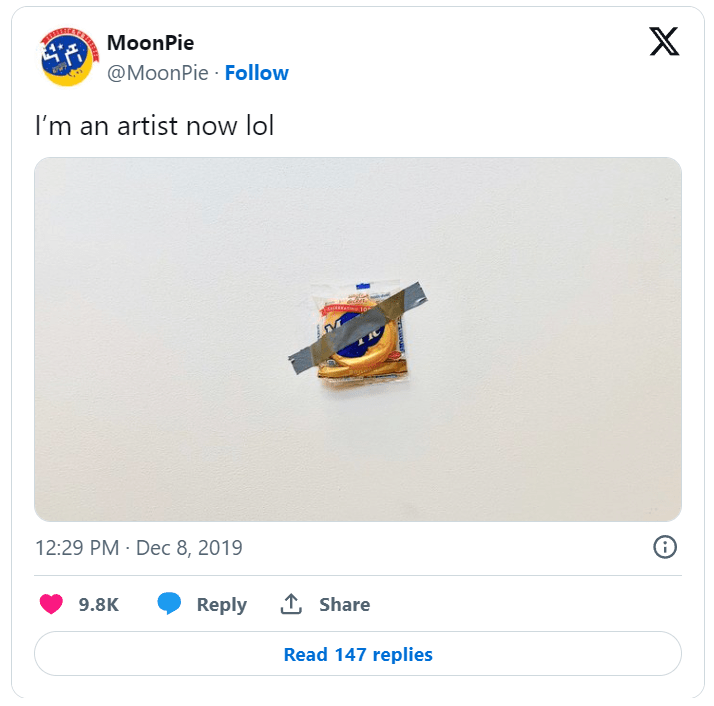
Personally, I don’t care what people consider “art.” An ordinary object does not in fact gain mystical power when becomes a piece of art. That power is imbued by the individual. It has social consequences for the art market, but it seems like the market can deal with things that are visually different like abstract art. People who don’t like it can just avoid it. One of the problems with AI-generated images “posing as” art is that they are visually similar to traditional art, making it hard for people to avoid if they want to. In my opinion, greater acceptance of AI images as art would help address this problem, since people would be more incentivized to freely label AI works as such instead of being sneaky about it. It remains to be seen how the market will deal with the inevitable influx of AI images as image generation continues to improve.
All that said, I do not feel optimistic about the future of AI “art.” Since it requires powerful computers instead of art supplies, it is much more subject to economies of scale, meaning it is likely to be dominated by just a few major companies if it becomes really practical to use in the future. This in turn means that it will be more driven by profit motive and have less artistic integrity (if any).
 thoughts on mind