
Trailer Park Boys is a long-running TV show in a mockumentary style that follows three characters, Ricky, Julian, and Bubbles, who live in a trailer park in Nova Scotia, Canada. The action follows the trio’s misadventures as they create illegal money-making schemes. Each season of the show typically begins with Ricky and Julian being released from jail and ends with them being sent back to jail.
Bubbles, named for his childhood love of a bubble-blowing machine, is the most level-headed and responsible of the three. He is cautious, lives a simple life, and prioritizes taking care of the many cats that roam Sunnyvale Trailer Park. Julian is the most clever and has the most formal education, usually planning out the group’s schemes. He values appearances and the respect of others. Ricky is often regarded as the least intelligent due to his small vocabulary and inability to understand many concepts, but has the greatest practical skill among the three, being able to fix cars, grow weed, and misdirect police and authority figures.
A stranger
Trailer Park Boys is about life between prison terms. Always trying to play the angles, always done-in by forces beyond their control, and always in the middle of a gunfight, Ricky and Julian are decent, hard- working guys trying to cope with the New World Economic Order. It’s not that the boys don’t know right from wrong, it’s just that “right” rarely presents itself.
…
At the center of Trailer Park Boys are Ricky and Julian, two guys whose lives were shaped by their experiences growing up in the Trailer Park. Their childhood was typical of most trailer park kids – stealing, fighting, smoking, drinking, scamming and listening to Van Halen. … as this inaugural season begins, both Ricky and Julian are just getting out of jail. They blame each other for this most recent incarceration and, now, as Julian prepares to start all over again, he refuses to talk to Ricky. Julian wants and tries throughout the series to go straight – but old habits die hard. And that’s just fine with Ricky.
IMDb plot summary
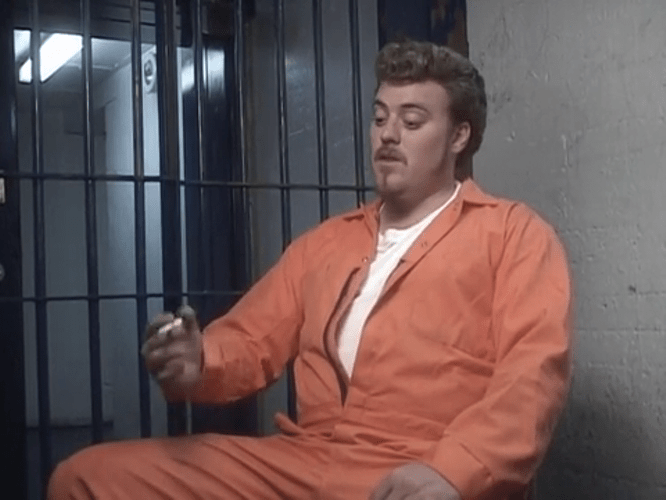
Ricky is very much at home in the Sunnyvale Trailer Park where he grew up. Outside the trailer park, he struggles to interact with mainstream society. As a high-school dropout with a criminal record and few employable skills, society rejects him. Unlike Julian, Ricky has no desire to integrate, choosing instead to live by his own rules and get by however he can.
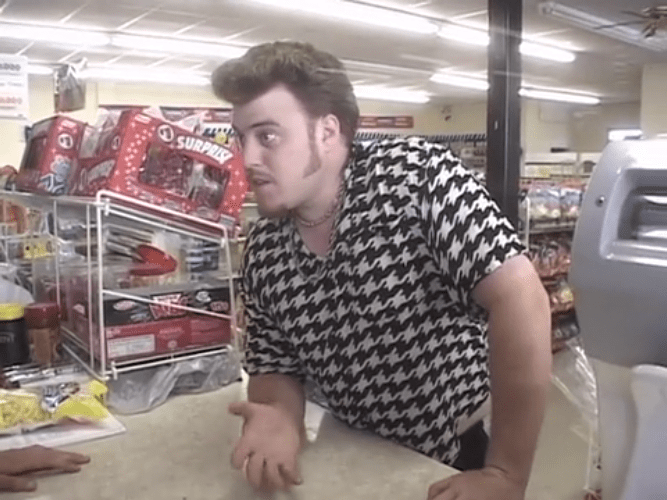
Ricky recognizes the refusal to follow norms and laws as a kind of freedom, and even at times expresses a kind of pity for Julian for wanting to go straight, such as in S1E2 “Fuck Community College, Let’s Get Drunk and Eat Chicken Fingers.” Ricky embraces freedom and finds contentment in simple things whereas Julian aspires to a “better” life.
“He lives in there in a palace and he’s all stressed out. I live out here in a car and I’ve got everything I need and I’m happy.”
Ricky (S1E2)
Bubbles, though he also enjoys the simple things, is too anxious about rule-breaking to fully realize his freedom.
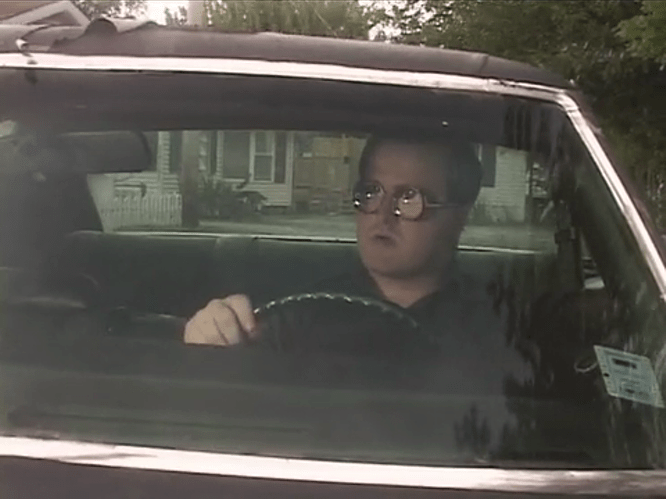
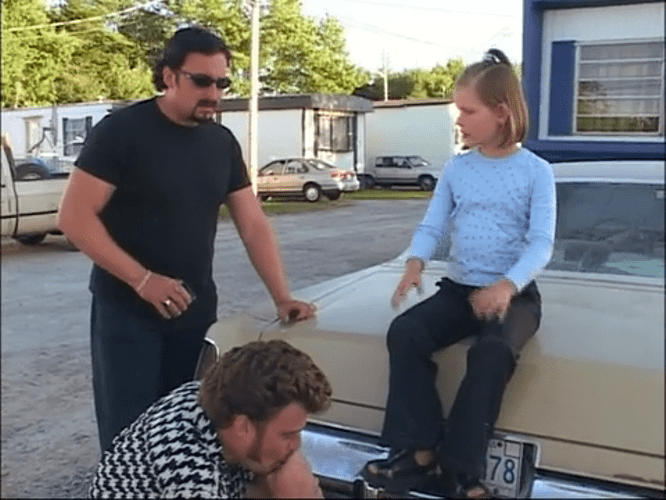
Ricky’s problems often come in the form of his inability to connect with his daughter and her mother (and later his grandson). His criminal activity and especially his frequent incarceration prevent them from having the kind of family relationship he desires. He is constantly pulled between a life of freedom and a life of commitment, and commitment always seems to lose out.
With his amorality and alienation from normal society, Ricky reminds me of Meursault, the main character in Albert Camus’ The Stranger, who is put on trial for murder after unintentionally killing a man. The two are not similar in personality, but rather in what they represent philosophically. They ultimately accept their condemnation by society, finding no sensible meaning in what happens to them. Neither really cares about being imprisoned, wanting largely just to be able to smoke and enjoy the other pleasures of life.
“But,” he said, “that’s exactly why you’re in prison.” “What do you mean that’s why?” “Well, yes—freedom, that’s why. They’ve taken away your freedom.” I’d never thought about that. I agreed. “It’s true,” I said. “Otherwise, what would be the punishment?”
Albert Camus, The Stranger
Jail is fun, and the food and stuff is really good there, but, y’know, I guess it’s more fun outside of jail and you can still do crazy things and get better dope and get drunk all the time and stuff like that, so… It’s not like we don’t like jail it’s just that we don’t really want to go back to jail anytime soon.
Ricky (S3E3)
While Ricky and Meursault did commit crimes, the condemnation they receive is largely focused on their character and not on the specific actions they committed which were illegal. In Meursault’s case, it’s the fact that he did not cry at his mother’s funeral, does not believe in god, and so on. In Ricky’s case, it’s his apparent disrespect for authority (e.g. by smoking and swearing in court as in S3E3, “If I Can’t Smoke and Swear, I’m Fucked”).
An absurd life of crime
If I accuse an innocent man of a monstrous crime, if I tell a virtuous man that he has coveted his own sister, he will reply that this is absurd. His indignation has its comical aspect. But it also has its fundamental reason. The virtuous man illustrates by that reply the definitive antinomy existing between the deed I am attributing to him and his lifelong principles. “It’s absurd” means “It’s impossible” but also “It’s contradictory.” If I see a man armed only with a sword attack a group of machine guns, I shall consider his act to be absurd. But it is so solely by virtue of the disproportion between his intention and the reality he will encounter, of the contradiction I notice between his true strength and the aim he has in view. Likewise we shall deem a verdict absurd when we contrast it with the verdict the facts apparently dictated. And, similarly, a demonstration by the absurd is achieved by comparing the consequences of such a reasoning with the logical reality one wants to set up. In all these cases, from the simplest to the most complex, the magnitude of the absurdity will be in direct ratio to the distance between the two terms of my comparison. There are absurd marriages, challenges, rancors, silences, wars, and even peace treaties. For each of them the absurdity springs from a comparison. I am thus justified in saying that the feeling of absurdity does not spring from the mere scrutiny of a fact or an impression, but that it bursts from the comparison between a bare fact and a certain reality, between an action and the world that transcends it. The absurd is essentially a divorce. It lies in neither of the elements compared; it is born of their confrontation.
Albert Camus, The Myth of Sisyphus
The absurdity of Ricky’s existence comes from the disparity between his lived experience and the expectations of normal society. Ricky can’t live his life without breaking the law, and it’s not because he has bad intentions: when he siphons gas in S3E3, he does so because he needs to get to the store to get more nicotine patches for his daughter, whom he wants to quit smoking cigarettes. In that moment, out of patches and out of gas, his sole option for helping his daughter is to break the law.
Ricky’s life is pervaded by such moments. He just wants to enjoy life and spend time with his friends and family, and the fact that he is in a position where the only way to do so is by breaking the law is absurd. The vision of people in normal society (and especially authority figures) of how one should live one’s life is totally incongruous with the circumstances Ricky perpetually finds himself in. Some, such as trailer park supervisor and former police officer Jim Lahey, see no viable solution and would prefer people like Ricky simply not exist. Philosophically, Ricky’s struggle is for his very right to be alive (fortunately for him and unlike Meursault, the criminal justice system has no grounds for actually executing him).
In this way Trailer Park Boys is an effective social commentary. Petty criminals like Ricky do exist and, like Ricky, are generally not nefarious evil people. They’re trying to get by the same as everyone else, but live in a world where breaking the law is the only option that makes sense. Authority figures and “upstanding” members of society are often all too willing to condemn such individuals out of hand. Since their behavior is against the rules, it’s rarely analyzed in terms of its actual harm, nor is that harm hardly ever compared to harm caused by people operating within the letter of the law, whose harm to others arguably overshadows that of all the petty criminals in the world combined. No, like Ricky and Meursault, criminals are condemned by society primarily for their character which ostensibly makes them criminals far more than their criminal acts do.
Still, Ricky despairs little of his life or his circumstances. He does what he must and enjoys what he can.
For the rest, he knows himself to be the master of his days. At that subtle moment when man glances backward over his life, Sisyphus returning toward his rock, in that slight pivoting he contemplates that series of unrelated actions which become his fate, created by him, combined under his memory’s eye and soon sealed by his death. Thus, convinced of the wholly human origin of all that is human, a blind man eager to see who knows that the night has no end, he is still on the go. The rock is still rolling.
Albert Camus, The Myth of Sisyphus
I leave Sisyphus at the foot of the mountain! One always finds one’s burden again. But Sisyphus teaches the higher fidelity that negates the gods and raises rocks. He too concludes that all is well. This universe henceforth without a master seems to him neither sterile nor futile. Each atom of that stone, each mineral flake of that night filled mountain, in itself forms a world. The struggle itself toward the heights is enough to fill a man’s heart. One must imagine Sisyphus happy.
 thoughts on mind