
There is a common model of belief about god that places a person’s belief on a 2D plane with one axis for belief and another axis for knowledge.
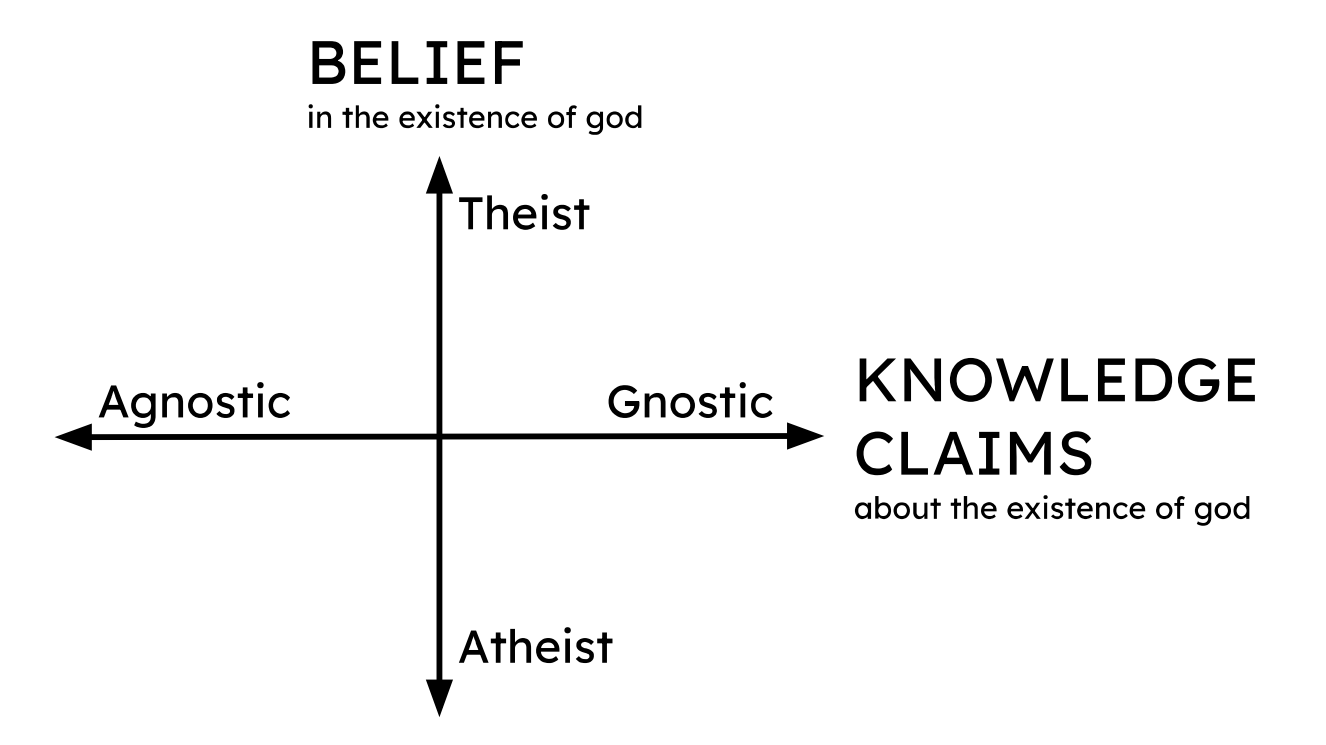
The vertical axis represents degree of belief in the existence of god. The horizontal axis represents the degree to which one claims to know that their belief is accurate. In general, I would say most atheists fall on the agnostic side and most theists fall on the gnostic side.
I propose a third axis, representing the degree to which one cares about their belief in god being accurate.
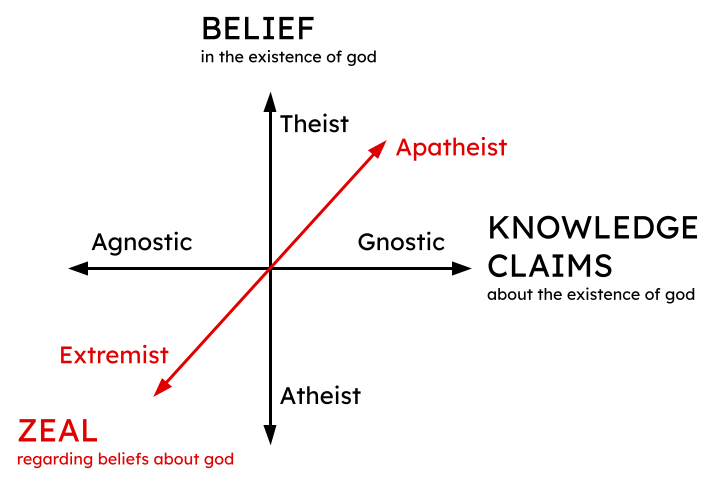
What is gnostic apatheism?
This is a term I made up just now. Roughly, it means claiming to know whether god exists but also not caring whether god exists. This may seem like a strange position to hold, and it is, but it’s also quite common in my opinion. I have encountered both theists and atheists whom I would ascribe this label to, though I think they form two separate strains of this belief.
Theists who are gnostic apatheists are people who subscribe to and loosely follow a religion without really taking it seriously. They don’t question their faith; they simply don’t think about religion very much at all. They have no interest in theology or philosophy. I associate this position most strongly with milquetoast mainstream Christians.
Atheists who are gnostic apatheists tend to have a view towards religion like, “I don’t care, and neither should anyone else!” They deride the very idea of even entertaining religious ideas but have no interest in deconverting the religious. This is an attitude of aloof superiority, similar to (and sometimes the same people as) libertarians who scoff at voting or getting politically involved.
There’s no real logical argument to be made against gnostic apatheism, I just find it annoying and hypocritical. It comes from a place of unreflectiveness and self-assuredness. It is not as bad as extremism, but in some ways it is more pernicious in its quiet unassumingness.
 thoughts on mind