
There are two mistakes people can make about their circumstances. The first is blaming circumstances for things that are actually under their control, and the second is denying the ways in which circumstances limit what they are capable of.
I have written in past blog posts about freedom and free will. I generally follow the existentialist position that humans are absolutely free, but deny this freedom and say “I have no choice” in order to shirk responsibility and assuage anxiety. This is what existentialists call bad faith. That said, circumstances do limit the range of options at any given time. So the question is: what is under our control and what is not under our control?
Looking at this from a perspective of causation is not useful in my opinion. From an outside perspective, all behavior is caused by chemical reactions and might as well be deterministic. Instead, I propose looking at it phenomenologically, or from the subjective point of view. We have the experience of making choices and the experience of not being able to choose. For example, I can choose to hold my breath at this moment; I cannot choose to stop my heart beating.
In general, the subjective range of options consists of those things which are physically possible for the brain to tell the body to do. “Physically possible” here includes having the required knowledge, e.g. it’s physically possible for me to verbalize any English sentence whatsoever, but I am unable to state the solution to the Goldbach conjecture.
Mental illness, neurodivergence, brain injury, the influence of drugs, and so on cloud this picture. It’s unclear (to me at least) how much brain states like these limit what is subjectively possible. We might get some answers by looking to dialectical behavioral therapy (DBT), in particular the dialectical part.
In the context of DBT, dialectics refers to holding two opposing ideas in mind at once. For example,
- My depression limits what I am able to do.
- I can choose to do those things anyway.
Believing you have agency in a situation will tend to enable action, whereas believing you have no agency will tend to prevent action. At the same time, acknowledging limitations lessens unproductive self-blame. It’s not useful for a depressed person to feel responsible for their symptoms, as this will likely worsen their symptoms. This dialectical approach can be difficult to wrap one’s mind around. Consider the following example:
- I am doing my best.
- I can do better.
Notice that this is not a direct contradiction. This doesn’t work:
- I am doing my best.
- I am not doing my best.
The dialectical approach unites ideas that are seemingly contradictory because of their implications. We must therefore question the validity of these implications. So for example, “I can do better” does not imply “I’m not doing my best” because “my best” can improve over time.
In this context, what are the mistakes I mentioned people make? The first is discounting one’s capacity to do things despite limiting circumstances. This is saying “I’m doing my best, and I can’t do any better.” As I said, this perspective discourages change. The second mistake is discounting limitations. This is saying “I’m not doing my best and I can be doing better.” This might motivate change, but is likely to prevent one from understanding why they’re not doing their best even when they seemingly want to, which can be frustrating. And like I said, it leads to self-blame and possibly feelings of shame and guilt. “If I am able to do better and choose not to,” the reasoning goes, “then I must be a bad/broken person.” This also impedes positive change.
This is why I find the dialectical approach to be the most useful. DBT balances change and acceptance by drawing from Hegel, Zen Buddhism, and Taoism.
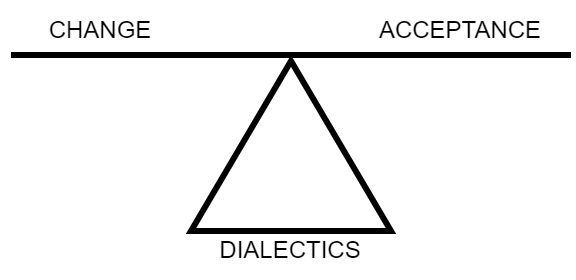

Important Opposites to Balance
DBTSelfHelp.com
- Accepting reality AND working to change it
- Validating yourself and others AND acknowledging errors
- Working AND resting
- Doing things you need to do AND doing things you want to do
- Working on improving yourself AND accepting yourself as you are
- Problem solving AND problem acceptance
- Emotion regulation AND emotion acceptance
- Doing something on your own AND asking for help
- Independence AND dependence
- Openness AND privacy
- Trust AND suspicion
- Watching and observing AND participating
- Taking from others AND giving to others
- Focusing on yourself AND focusing on others
 thoughts on mind