
Special relativity is a theory of motion developed primarily by Albert Einstein in the early 20th century. Its precursor was Galilean relativity, which basically states that velocities are relative. One of the key features special relativity is the speed of light c being a constant. This means its speed is not relative, and this has some interesting consequences.
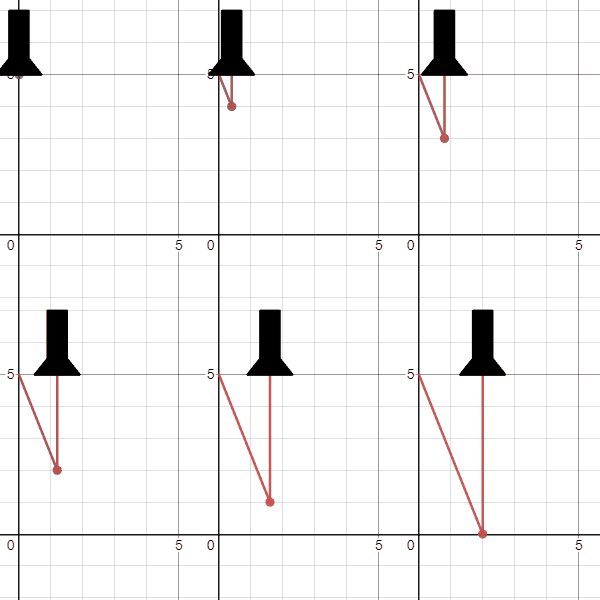
Consider a very fast train passing by a train platform. Suppose there is a person inside the train who shines a flashlight at the floor. In this person’s frame of reference, the light must travel at the speed of light straight down some distance x to reach the floor. But in the frame of reference of a person on the platform, the light is not moving straight down but rather travels diagonally due to the motion of the train. Thus it travels at the speed of light some distance longer than x and takes longer to reach the floor. The two people can measure the amount of time it takes for the light to hit the floor and get different times. It is time that is relative. Time and distance are relative in fact, and these make up the 4-dimensional spacetime.

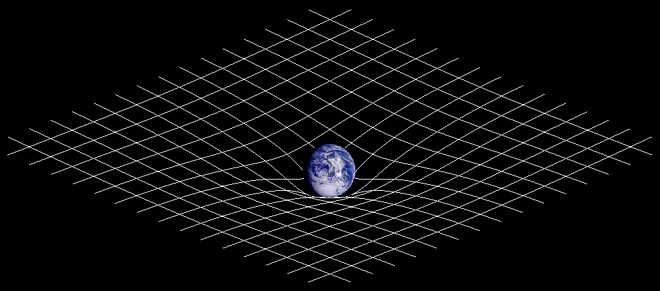
Special relativity is a special case of general relativity, which accounts for the bending of spacetime from gravity.
Another important feature of special relativity is c as a “speed limit.” This has interesting consequences as well. Since nothing can travel faster than light and light takes time to travel, we can see only into the past, with more distant objects being in the more distant past. We also cannot affect things quickly in a location that is very distant. It takes time to travel and so the effect will happen in the distant future.
This is a light cone. For simplicity, let’s consider just 1 spatial dimension along with time. A point on this graph is a snapshot of a particular location at a particular time. The present at your current location is represented as (0, 0). Above this point is the future, below is the past. Moving horizontally corresponds to a change in location.
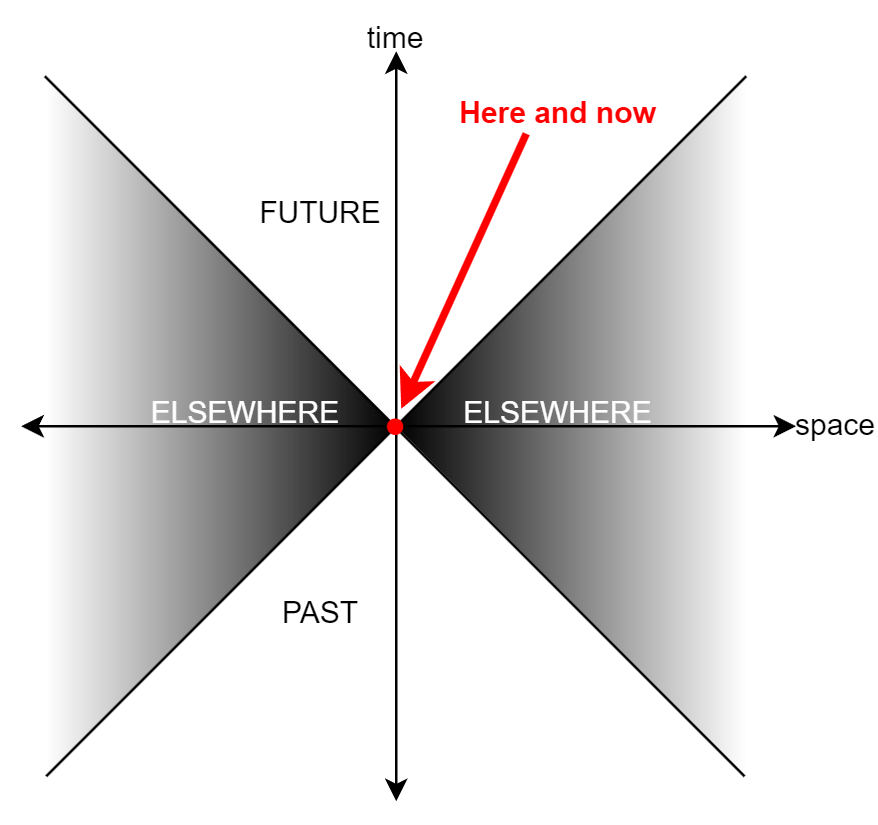
These two diagonal lines represent the speed of light as a relationship between time and distance and define your light cone. The bottom of the cone is the visible past, and the top of the cone is all the times and places you could possibly be in or affect in the future. Outside the light cone there can be no causal interaction. This region of spacetime is simply known as “elsewhere.” It is not possible to travel to, see, or affect “elsewhere.”
So the 4D “fabric” of spacetime or Minkowski space, a kind of manifold, has a special structure defined by the speed limit c. In “flat” spacetime, light always travels in straight lines. Where spacetime is curved by gravity, light follows the shortest possible path (called a geodesic). This causes light to bend around massive objects like stars, resulting in gravitational lensing.

Every massive object has an escape velocity, the speed at which something ejected from the object will be able to continue moving away and not get pulled back towards the object. Since c is a cosmic speed limit, an object massive enough to have an escape velocity greater than c is impossible to escape, even for light. Such an object is called a black hole: black because it reflects no light, and a hole in the sense that it “sucks things in,” never to escape. Black holes were predicted mathematically before eventually being discovered.

 thoughts on mind

