
For most of human history, the age of the earth was unknown. Many believed it was created at some point in the past by supernatural forces, and others hypothesized that the earth always existed. Within the Abrahamic tradition, genealogical lists have been used to trace back to Adam and the date of creation as described in Genesis. The Hebrew calendar still counts the year from the traditional Jewish date of creation.
According to ancient Jewish chronologies, the creation of the world dated back 4339 [BCE] or 3761 [BCE], depending on tradition. Later on, the medieval Christian culture would inherit the Jewish vision of time, and the world beginning was believed to be between 5300 and 5500 [BCE].
Bersanelli, M. (2022) p. 409. The Age of the Universe. In Alessandra Campo & Simone Gozzano (eds.), Einstein Vs. Bergson: An Enduring Quarrel on Time, pp. 407-432.
There have been many different calculations, but the general consensus on this timeline is that the Biblical creation story takes place 6,000 to 10,000 years ago.
Creationists react to an old earth
Like heliocentrism, the discovery of an old-but-not-eternal earth was seen by some as a threat to Christianity. Especially significant was the rise of modern geology, astronomy, and biology, from around the 17th to 19th centuries. By the beginning of the 20th century, an old earth was widely accepted within science. The theory of evolution was particularly alarming to some Christians: not only does the theory reinforce the idea of an old earth, but also the evolution of humans specifically from “lower” animals is threatening to their belief system. To many Christians, this is far more important than the age of the earth itself. Even if Genesis is not literally true and the earth is old, they find it difficult to maintain Christian beliefs without holding that humans are a special creation by God. As a result, there exist individuals who believe in evolution almost entirely, with the sole exception that they believe humans are a special creation and did not evolve.
There are many different versions of Christian belief about the origin of the universe, the origin of the earth, the origin of life, and the origin of Homo sapiens. This post is about those most extreme of Biblical literalists, who reject the scientific answer for all of these. This strain of Christianity has historically been prominent in the US, and in the early 20th century a movement began to stop the teaching of evolution, culminating in the famous Scopes Monkey Trial of 1925. The trial was a publicity stunt. John T. Scopes was convicted of teaching evolution in violation of the Butler Act (his conviction was later overturned on a procedural technicality), and the law stood in Tennessee for decades before eventually being repealed in 1967.
Be it enacted by the General Assembly of the State of Tennessee, That it shall be unlawful for any teacher in any of the Universities, Normals and all other public schools of the State which are supported in whole or in part by the public school funds of the State, to teach any theory that denies the story of the Divine Creation of man as taught in the Bible, and to teach instead that man has descended from a lower order of animals.
The 1925 Butler Act of Tennessee
Other states had similar laws, and all such laws were seldom ever enforced. In the 1920s, the debate was often framed as one internal to Protestantism between fundamentalism and modernism. There was little concern, even by the courts, that anti-evolution laws gave Christianity preferential legal status. However, by the late 1960s this perspective had changed, and the Supreme Court struck down these laws as violating the First Amendment. This resulted in a rhetorical shift by creationists to attempt to present secular arguments rather than theological ones.
Creation “science”
Christian apologetics is the practice of making reasoned arguments in defense of Christian beliefs. In the late 20th century, Biblical literalist apologists established creation science, a program aimed at undermining confidence in the scientific evidence for the origins of life and the universe. A common criticism of creation science is that, while it often imitates the appearance of mainstream science, it begins with its conclusion and works backwards to find evidence. The scientific veneer is an attempt to borrow the legitimacy of science in order to be more convincing to a populace that has come to view science as generally reliable. Internally to these religious groups, creation science is ultimately unimportant. The adherents are happy to simply believe what the Bible says without any further investigation. The purpose of creation science is to inoculate adherents against arguments or evidence that would undermine their religious beliefs, legitimize the group’s religious beliefs in the public sphere, and assuage the doubts of potential converts who may be concerned about conflicts between science and religion.
It is not worth pretending that any creationist arguments are made in good faith. The arguments are consistently dishonest. Some creationists have been relatively open about their ends-justify-the-means mentality. Over time, specific arguments for creationism have become less convincing due to mounting scientific evidence, and the result is that the conclusion stays the same but the arguments get updated. However, creationists are beginning to find themselves backed into a corner, with their arguments running dry in the face of more and more overwhelming scientific evidence.
Microevolution and created kinds
The most naïve version of creationism states that presently existing animal species were created in their current forms. In Genesis 1, the Bible uses a term which is usually translated kind in English. In Latin, this is the word species.
And God created great whales and every living creature that moveth, which the waters brought forth abundantly after their kind, and every winged fowl after his kind; and God saw that it was good.
Genesis 1:21 (KJ21)
creavitque Deus cete grandia et omnem animam viventem atque motabilem quam produxerant aquae in species suas et omne volatile secundum genus suum et vidit Deus quod esset bonum
Genesis 1:21 (Latin Vulgate) (emphasis added)
In Aristotle’s early taxonomical work, he used the terms genos (literally “race” or “clan”) and eidos (literally “form” or “kind”) which became genus and species in Latin. When Carl Linnaeus created his taxonomic system, he used these terms in a slightly different way, with Aristotle’s species referring to (variously) what Linnaeus called genus or family. Linnaeus’ version is approximately what we mean in biology today when speaking about family, genus, and species.
Kent Hovind, a prominent creationist apologist, emphasizes the phrase “[bringing] forth … after their kind” as meaning a group of animals that can produce fertile offspring. This lines up with what’s called the biological species concept, but Hovind rejects the idea that what we now call species are the same as what the Bible calls kinds.
This is all important because the capacity for species to change over time is now so obvious that the most naïve version of creationism is completely untenable. We can observe it in real time in fast-reproducing species and we can observe it in paleontology. Adaptation is an undeniable fact even to creationists.
Additionally, Noah’s Ark presents a challenge for the naïve view because we now know that there are tens of thousands of individual species of land animals. This biodiversity was not known at the time the book was written. A pretty easy solution is that the kinds and animals on the Ark were the same kinds that were created in the first week. Like humans, these animals then diversified (within their kinds) to become the animals we see today. So the story goes.
This is evolution. Hovind even attributes it to natural selection. That’s a huge (but absolutely necessary) concession for creationists to make. It is what creationists call microevolution, which is variously defined as evolution within a species or evolution within a kind. Creationists generally agree that a kind is like Aristotle’s eidos, or what we would now call family or genus. That is, they will go so far as to accept speciation as a part of evolution, but still reject the idea that organisms could diversify enough to be in a different family or genus.
Linnaeus was a creationist, but his taxonomic system is now known to roughly represent phylogenies (lines of descent). Modern creationists agree with this conclusion except that they cut it off at some relatively arbitrary point. Where the cut-off is exactly depends mostly on how much that person can distinguish between animals by looking at them. As a result, familiar mammals are often separated into kinds at the genus level, but amphibians, insects, etc. may be separated at the order level or even higher.


Above: though superficially similar looking, the two frogs pictured above are in different families, making them taxonomically about as distantly related as walruses and raccoons.


This is an area where creationists have backed themselves into a corner. There is no consistent, unambiguous definition of a created kind; that is, there are no criteria by which a newly discovered organism could be unambiguously sorted into a kind or identified as a previously unknown kind. Kinds are purely based on human perception and opinion about what “a kind of animal” means. I want to state clearly that there is nothing wrong with describing animals with such a loose and informal system, however it is totally useless to biological science, paleontology, etc.
Moreover, the “microevolution” distinction is an artificial one. Taxonomic levels are, in fact, human inventions. Microevolution and macroevolution normally refer to evolution within a species versus speciation, but since creationists accept speciation, their use of this distinction is nonsensical. Again, microevolution for the creationist refers to evolution within a kind, but biologically we can’t distinguish between evolution within a kind and evolution into multiple different kinds.
Another mistake creationists make with this line of argument is assuming that macroevolution requires a line of organisms to go from one kind to another. This contradicts the law of monophyly, which roughly states that any organism must be the same kind as its parents. Speciation does not occur when an organism goes from being one species to being a different species; it happens when a single species diversifies enough that two of its descendants, though still the same kind of organism as their common ancestor, are not the same species as each other.
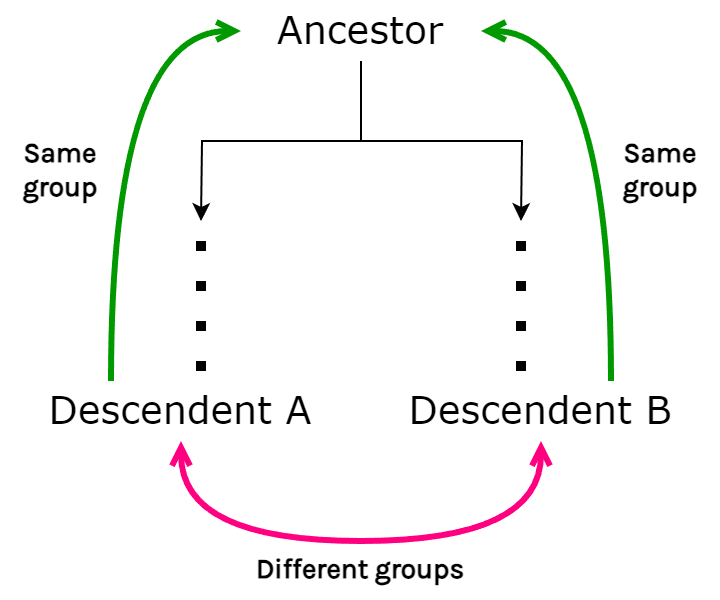
To explain it a slightly different way, you are directly related to your grandparents but only indirectly related to your cousins.
Radiometric dating and the heat problem
In general, creation “science” is characterized by continually making concessions to mainstream science over time, requiring more and more nonsense to explain how creationism can still be consistent with plainly observable facts. For a long time, radiometric dating of rock was rejected outright by creationists because it clearly shows the earth to be older than 10,000 years. However, the successful practical application of radiometric dating in mining and geology (e.g. to locate coal or oil deposits) has forced creationists to concede that the principles underlying radiometric dating are fundamentally correct.
The “solution,” if you can call it that, is a proposal that the rate of radioactive decay was different in the past. Not only does this contradict modern physics (with no alternative physical explanation), it also introduces a massive problem for creationists. Radioactive decay, namely gamma decay, releases energy into the surrounding environment. In ordinary rocks, this process is extremely slow, so the radiation has very little effect. However, if a rock must decay by the same amount in a shorter timespan, it will have to release energy much faster. In order to “fit” all the decay we observe into a 6,000 year time period, the energy released would be enough to vaporize the earth’s oceans and kill all life. This is the heat problem. While some creationists are continuing to work on possible explanations for where all this energy went, the current position of creation “science” is that it simply requires a miracle from God.
This is an absurd conclusion because anything can be explained by appealing to a miracle from God. God could have created the world last Tuesday and just set everything up (including our own memories) so that the universe appears to be older than a week. Everything about our perception of reality can be called into question if we allow an omnipotent God as a possible explanation. This is precisely why science operates on the basis of methodological naturalism: not claiming that the supernatural does not exist, but never using the supernatural as an explanation. Science studies the natural, and anything supernatural is outside the scope of things science can investigate.
But could God have done a miracle to fix the heat problem? Sure, in exactly the same sense that everything we think we know could be wrong. As a theological or philosophical position that’s not really a problem, but at that point creation “science” is abandoning science completely. Crucially from an apologetics perspective, it isn’t convincing to anyone who does not already believe in a young earth.
(For more information about the heat problem, Gutsick Gibbon on YouTube has an excellent and very detailed video about the topic.)
Intelligent design and “teach the controversy”
Intelligent design (ID) has never been anything aside from creationism. It is not a scientific hypothesis or theory because it is not falsifiable and it does not generate novel predictions. Evolution does both. For example, if we observed a giraffe give birth to a zebra, then our current understanding of evolution and genetics would be falsified. Evolution has many successful predictions, for example it predicted that, within a certain range of strata, about 375 million years old, we should find intermediate forms between fish and terrestrial animals. It was specifically paleontologist Neil Shubin who predicted this, and he and his team discovered Tiktaalik in 2004, a 375-million-year-old amphibian-like creature. In the almost two decades since, many more of these “transitional” animals have been discovered.

Intelligent design is also genuinely incompatible with evolution. It is not to be confused with theistic evolution, i.e., the view that evolution is correct and that God exists and made evolution the way it is.
Like the name “creation science,” ID was developed to make creationism seem more like science and less like religion, specifically so that it could be taught in schools. Creationists differ on what exactly their stated goal is for public school curricula. Clearly they would prefer only creationism be taught, but they largely understand that that is impossible. For most, the solution is to present both perspectives and tell students that people disagree about which one is true. While sociologically somewhat accurate (in the US), there is no such controversy within biological science. This is illustrated by “Project Steve,” a list of scientists (mostly biologists) named “Steve” who endorse evolution.
NCSE’s “Project Steve” is a tongue-in-cheek parody of a long-standing creationist tradition of amassing lists of “scientists who doubt evolution” or “scientists who dissent from Darwinism.”
Creationists draw up these lists to try to convince the public that evolution is somehow being rejected by scientists, that it is a “theory in crisis.” Not everyone realizes that this claim is unfounded. NCSE has been asked numerous times to compile a list of thousands of scientists affirming the validity of the theory of evolution. Although we easily could have done so, we have resisted. We did not wish to mislead the public into thinking that scientific issues are decided by who has the longer list of scientists!
National Center for Science Education
As with climate change, gender as a spectrum, and some other politically charged issues, there is not in fact any meaningful controversy or dispute within science. The only disagreement typically comes from scientists working in unrelated fields, for example there are some chemists who are creationists, economists who deny climate change, mathematicians who disagree with the modern understanding of sex and gender, and so on.
While creationists like to associate themselves with science for credibility, they also often believe that science is corrupt and conspiratorial. For example, there are beliefs among many creationists that in order to be a biologist, you are required to affirm a belief in evolution, or that only studies affirming evolution will get funded or published, and so on. This is common to all forms of science denial including the other examples listed in the previous paragraph. In general, this view greatly overestimates how much the scientific community care about one another’s personal beliefs.
Creationism and the flat earth, or: How obvious does something have to be before denying it becomes untenable?
Biblical literalism is a funny thing. Like with the specific case of creationism, literalism in general is obliged to make concessions to justify the Bible saying things that are very obviously not literally true. For example, ancient Hebrew cosmology viewed the earth as being flat and covered by a dome (the firmament), beyond which was a great ocean of water. Most flat earthers I have seen are Biblical literalists, but most Biblical literalists are not flat earthers. This is seen as a bridge too far in terms of rejecting plainly observable facts.
But why is that, I wonder? The degree to which one must reject observable reality in order to embrace young earth creationism is as extreme, in my opinion, as believing the earth is flat. A young earth flies in the face of everything we know about biology, geology, physics, astronomy, cosmology, medicine, archaeology, paleontology, anthropology, and on and on. My best guess is that the differences are, first, ignorance of the facts that contradict a young earth compared to the facts that contradict a flat earth, and second, a lack of ridicule of creationism in the public sphere compared to flat earth. Creationism– not its believers, but the idea itself –deserves to be derided as obviously false. At the same time, the public should be scientifically literate enough to understand why it deserves derision.

Most ordinary creationists do not understand evolution or creationism. By that I mean they often don’t know any apologetics or use arguments from apologetics that are decades old and are no longer used by creationist apologists. An example of the type of argument I’m talking about is Ray Comfort’s banana. The banana, he argues, is nutritious, tastes good, fits easily into a human hand, has a natural “wrapper,” and so on, so it must have been designed for human consumption. The kicker here is that Comfort is mostly correct, but it was “designed” that way by humans using artificial selection. The bananas that evolved naturally are far less conducive to human consumption.

In general, organisms eaten by humans in developed countries are virtually all modified from their natural forms to make them larger, more productive, less susceptible to disease, more tolerant of different climates, better tasting, have a better texture, and so on.
This is just an example. Other outdated arguments might include rejecting radiometric dating entirely, rejecting speciation, rejecting the existence of non-avian dinosaurs, and so on.
Christian creationism vs. atheistic evolution (a false dichotomy)
This is a way of framing the creationism debate that is still commonly used. That is surprising to me because of how obviously incorrect it is. On one hand, there are many more creation stories than the one in the Bible, so arguments against evolution are definitively not arguments for Biblical creation. On the other hand, evolution has nothing directly to do with atheism. While there are virtually no atheists in the US who reject evolution, it would be perfectly consistent for them to do so. In fact, atheism does not entail a rejection of the supernatural in general, so a person could believe in no god while believing animals came into existence in their current forms by supernatural means. More importantly, however, most people who believe evolution is true are not atheists.
In many arguments, evolution, naturalism, and atheism are conflated. Since many prominent opponents of creationism are naturalists and agnostic atheists, this is seen as confirmation. But again, there is nothing logically connecting these different ideas. Evolution, as with all science, entails methodological naturalism, as mentioned above. However, nothing about evolution precludes the supernatural or the existence of god; likewise, (philosophical) naturalism does not entail belief in evolution and arguably does not require the rejection of a god; and finally, atheism requires neither evolution nor naturalism.
What evolution is and is not
Many words used in science are also used in other contexts, even in different areas of science, to mean different things. The word “evolution” can refer to the biological theory of evolution, the evolution of Pokémon (which is more like metamorphosis), or indeed any sort of change over time. The way creationists use the term is rather bizarre, claiming to use it as a technical scientific term but using it in a way no scientist or field of science would.
According to young earth creationists, “evolution” encompasses the big bang theory, stellar nucleosynthesis, the formation of the earth and solar system, the geological history of the earth, abiogenesis, biological evolution, and sometimes even cultural development. In reality, of course, these are all separate ideas. Biological evolution does not require stellar nucleosynthesis, it only requires living organisms, nor does stellar nucleosynthesis imply biological evolution must be true. Looking at these theories collectively we can, for example, deduce that the atoms of oxygen, carbon, potassium, sodium, iron, etc. in living things came from stellar nucleosynthesis, but that fact is not essential to either evolution nor nucleosynthesis.
Abiogenesis (living organisms arising naturally and chemically from nonliving building blocks) is the biggest one. Most creationists I have encountered insist that abiogenesis is necessary for the theory of evolution, and since we don’t know how abiogenesis happened, the entirety of evolution collapses. This is mistaken for a couple reasons.
First, evolution does not require abiogenesis. To paraphrase Dapper Dinosaur, we can infer that a wrecked car on the side of the road was the result of an auto accident without knowing where that car was manufactured. Evolution tells us about things that are already living, and simply isn’t concerned with how living things originally came to be. It could be the case that the first life was created via miraculous divine intervention and then proceeded to evolve naturalistically, meaning abiogenesis could be false while evolution is true.
Second, scientific theories simply don’t rest on logical foundations in that way. Charles Darwin didn’t know about genetics or DNA, and his understanding of how evolution happened was limited. Darwinian evolution has been superseded by the modern theory of evolution. However, Even if Darwin had posited that traits are passed from parent to offspring by magical fairies, his theory of evolution would still be mostly correct. Similarly, Newtonian mechanics was superseded by quantum mechanics, which showed Newton’s assumptions to be false, but Newtonian mechanics is still mostly correct. In many ways the foundations of a scientific theory are the least important, the most important thing being how the theory actually explains and makes predictions about things.
Conclusion
Creationist arguments have changed over time (one might even say they evolved). As weak arguments become less and less convincing, or legal or rhetorical strategies fail, creationism is forced to make more and more concessions. This is the transition from “dinosaurs didn’t exist” to “dinosaurs existed, but aren’t the ancestors of modern birds;” from “radiometric dating doesn’t work” to “radiometric dating works but radioactive decay was much faster in the past;” from “animals can only make adaptations within their species” to “speciation can occur, but these different species are the same ‘kind’ of animal;” and so on. Creationism was kicked out of the public schools and the intelligent design reskin has (mostly) failed to bring it back into schools. Young earth creationism relies almost exclusively on ignorance to maintain itself as a belief system. Old earth creationism is maintained by a lack of understanding of some particular fields of science, including biology and paleontology.
Adherents seem to cling to these ideas out of some kind of fear of what the world would be like if the Bible is not 100% literally true. And yet, they tend not to believe in ancient Hebrew cosmology. They do not seem to notice the majority of religious people in the world, and in particular the majority of Jews, Christians, and Muslims, who believe evolution is correct. They do not seem to care that the Catholic Church and most Protestant churches interpret Genesis non-literally. I have heard Ken Ham say (paraphrasing) that if Genesis is not literally true, then everything in the Bible is open to questioning, including Jesus’ divinity and resurrection, and we can’t have that. There is also a concern, I think, about original sin and the story of Adam and Eve being literally true. This story is their basis for characterizing humanity as wicked and evil, which in turn allows them to maintain an “us-versus-them” mentality. Never mind that one could believe in all these things while also abandoning the idea of a young earth. The problem is not one of direct contradiction, but rather of opening the Bible to questioning in any capacity. Not being allowed to ask questions is a hallmark of fundamentalism.
 thoughts on mind

