
How can a rocket work in empty space without something to push against? While you may or may not be aware of the answer yourself, this question is perplexing to many people. I invite you to consider why this situation is confusing. I assure you it is not a matter of mere ignorance, and you might not understand the answer as well as you think. Just what is the difference between moving by “pushing against” something and moving without “pushing against” anything?
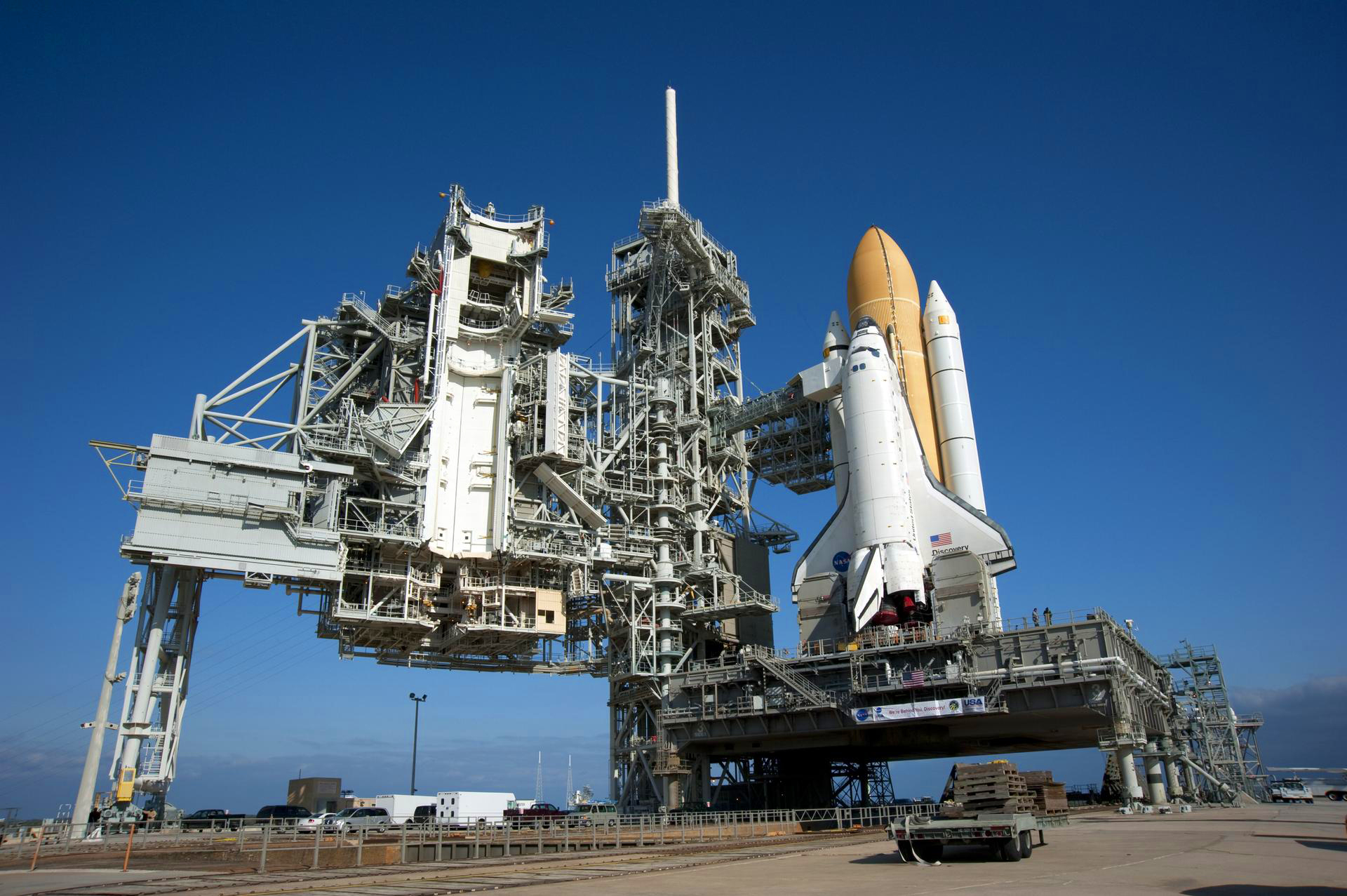
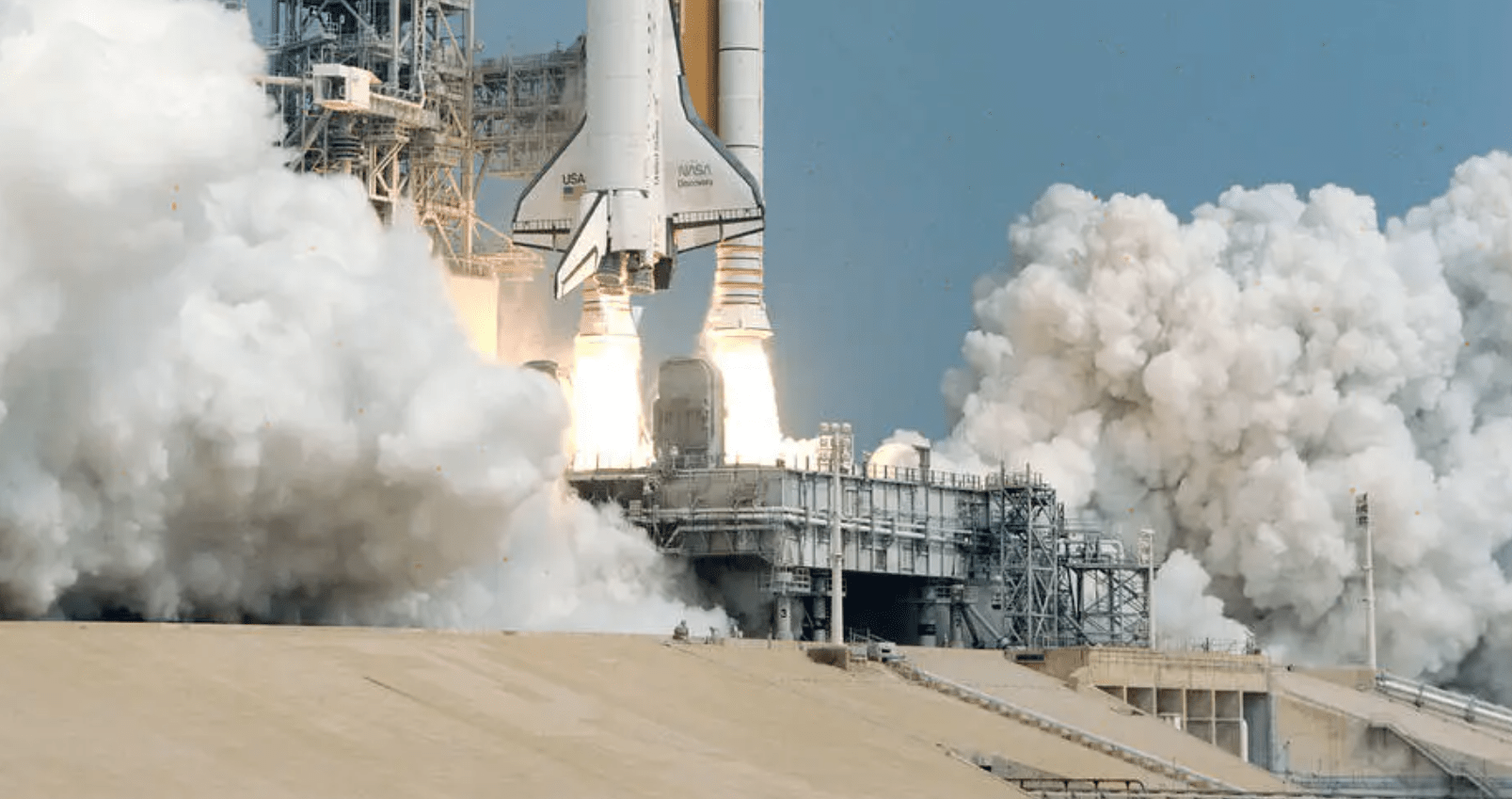
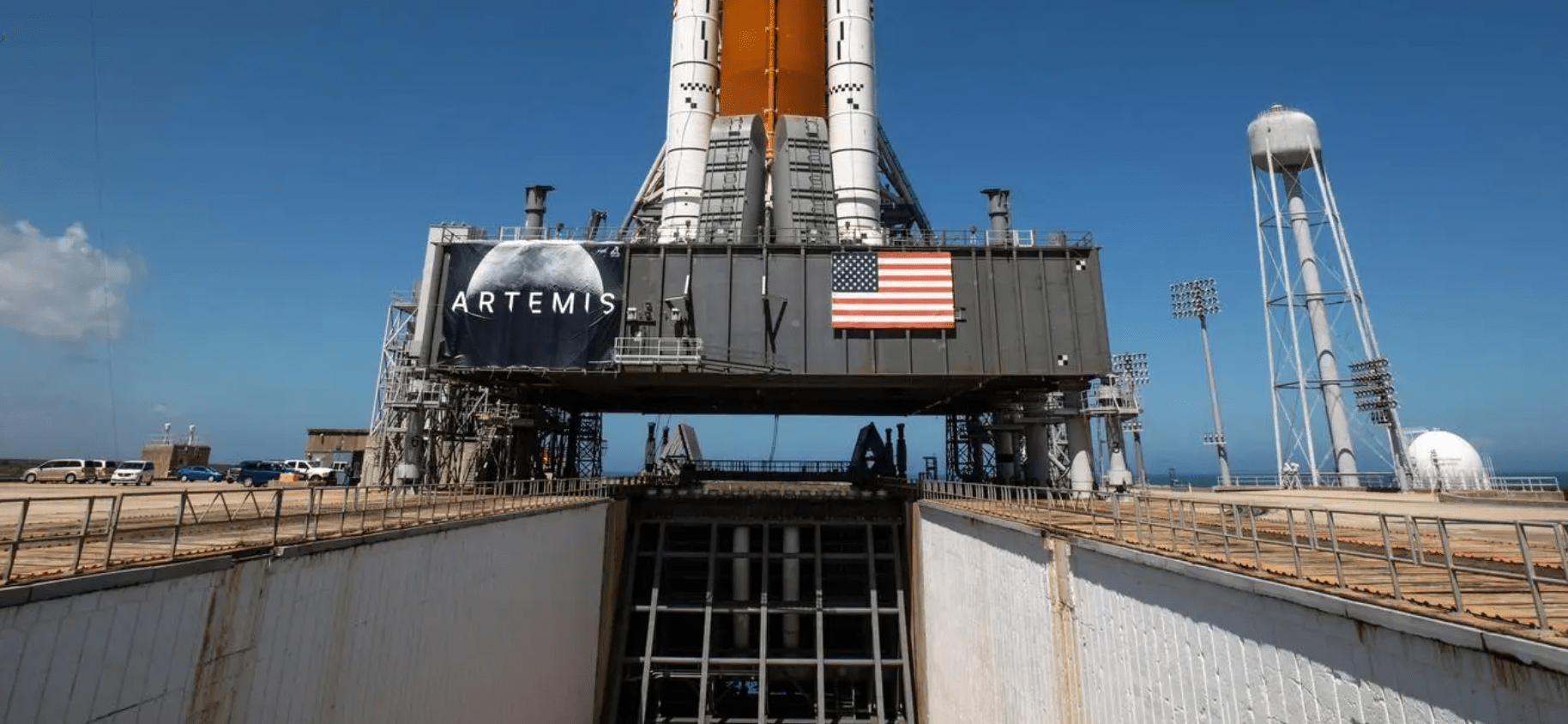
Note that even when a rocket launches, it is not pushing against the earth to create lift. Launchpads are specifically designed not to allow pressure to build up beneath the rocket, since that would be dangerous. Instead, the exhaust from the rocket is intentionally directed outward horizontally by the way the launchpad is designed. Some rockets do take off more or less directly from the ground, or are launched from a tube or barrel, but engineers always ensure that exhaust does not build up undue pressure behind the rocket. (For this discussion we are only interested in traditional combustion rockets and not alternative propulsion technologies that may use very different approaches.)
A brief interruption for some physics information
The tables below can be skipped over, especially if you are familiar with basic physics. I will explain most of these things as they come up. I recommend using this information as a reminder of some concepts if you have not done any physics in a long time, as a quick reference to look back to throughout the post, or to make you aware of topics for further reading.
Symbol and unit reference:
| Symbol | Units | Important equations |
| d distance | Meters (m) | |
| t time | Seconds (s) | |
| m mass | Kilograms (kg) | |
| v velocity | Meters per second (m/s) | v = d/t |
| a acceleration | Meters per second per second (m/s2) | a = v/t |
| F force | Newtons (N) | F = ma |
| P momentum | Kilogram-meters per second (kg × m/s) | P = mv |
| W work | Joules (J) | W = Fd |
| KE kinetic energy | Joules (J) | KE = ½ mv2 |
Important laws of physics:
| Newton’s 1st Law | An object at rest will stay at rest and an object in motion will stay in motion, unless acted on by a force. |
| Newton’s 2nd Law | Force is proportional to mass and acceleration (F = ma). |
| Newton’s 3rd Law | Every force on an object creates an equal and opposite force called a normal force. |
| Conservation of momentum | In a closed system, no matter how objects interact, the total sum of all objects’ momentums will stay the same. |
| Conservation of energy | In a closed system, no matter how objects interact, the total amount of energy will stay the same (but could be in many different forms, including kinetic energy (motion), heat, sound, light, chemical potential energy (as in food or gasoline), elastic potential energy (as in a spring), gravitational potential energy, etc.) |
First, how does pushing work?
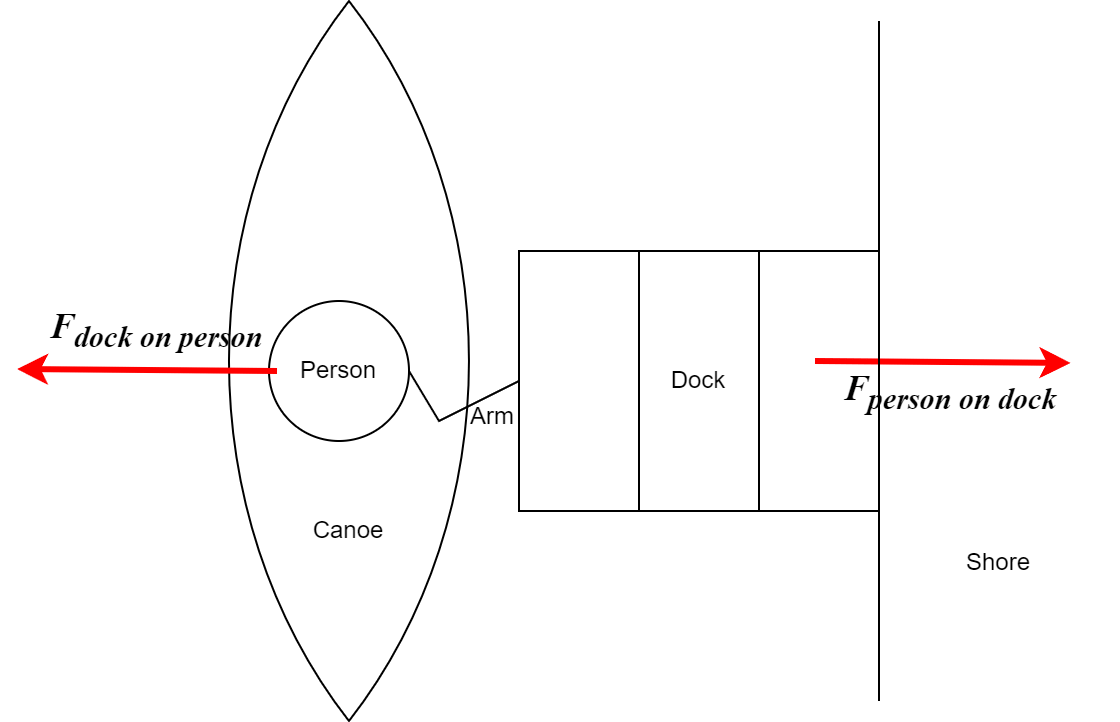
People are very familiar with the concept of pushing off. Cars move by pushing against the road, propellor planes push against the air, and so on. It is perhaps most easily illustrated by a boat. Let’s imagine a person in a canoe gently pushing off against a dock by hand. As their muscles contract, straightening their arm, they exert a force on the dock. By Newton’s 3rd Law of Motion, the dock exerts an equal and opposite force on the person (called a “normal force”). Let’s assume for the sake of this thought experiment that the person is firmly attached to the canoe and the dock is firmly attached to the earth, and also that the air and water have a negligible amount of friction.
In terms of time and acceleration
By Newton’s 2nd Law of Motion, a force F applied to a mass m causes an acceleration a according to the formula F=ma. We can find acceleration in terms of force and mass by rearranging this formula as a=F/m. Let’s do some calculations. First, let’s say for this thought experiment that the person+canoe weighs 150 kg (about 330 lbs). The earth weighs about 6 septillion kg (6 × 1024 kg or 1.3 × 1025 lbs). Finally, let’s say that the force applied by the person is 18 N (this is about 4 pounds of force). Since the same amount of force is being applied to both the person and the earth, they must both accelerate in opposite directions.
The acceleration of the person in the canoe is 18 N divided by 150 kg, or 0.12 m/s2. In other words, each second their speed increases by 0.12 meters per second. Because the mass of the earth is so much larger, the acceleration is much smaller, only about 3 × 10-24 m/s2. That means that in one second, the earth’s velocity in that direction would increase by 0.000000000000000000000003 m/s. This motion is imperceptible (it would take quadrillions of years to move 1 meter), especially considering the size of the earth and the fact that we normally use the earth as our frame of reference, meaning it appears as if the earth remains stationary while the person in the boat gains velocity.
In terms of momentum
Another law of physics is the law of conservation of momentum. If the earth and the boat are initially at rest with respect to each other, then interact such that they are moving with respect to each other, the total momentum of the boat-earth system must still be zero. Since the boat and the earth are moving in opposite directions, their momentums must be equal in magnitude in order to cancel each other out. Momentum is measured in units of mass × velocity. If we suppose that the duration of pushing was two seconds, then the boat ends up moving west at 0.24 m/s and the earth ends up moving east at 6 × 10-24 m/s. We can observe that the math works out if we multiply each velocity by the corresponding mass:
150 kg × 0.24 m/s = 36 kg × m/s
(6 × 1024 kg) × (6 × 10-24 m/s) = 36 kg × m/s
In terms of work and energy
By creating motion where there previously was none, the person pushing off from the dock has increased the kinetic energy of the system. This energy came from chemical energy (calories) stored in the person’s body which was transformed into kinetic energy (and heat) by doing work. In physics, work is essentially any time energy is used to move something. As with friction, we can ignore the small loss of energy through heat in order to simplify the situation.
One way to define work is a force applied over a distance: W=Fd. (Technically F and d are vectors and the multiplication here is a dot product, but we can gloss over that for our example.) Let’s say the person pushes the boat a distance of 24 cm or 0.24 m. The work done on the boat is:
18 N × 0.24 m = 4.32 J (joules of energy).
This must be the amount of kinetic energy the boat gained. We can use the formula for kinetic energy KE=½mv2 and rearrange it to solve for velocity:
v = √(2KE/m).
And now, using our known energy and mass:
vboat = √(2 × 4.32 J / 150 kg) = 0.24 m/s
We can see that the math works out since this is the same velocity we calculated using acceleration and time above.
Other examples
A spring
Since we ultimately want to investigate rockets, let’s discuss systems we can set up and “let go” rather than requiring active human intervention. Imagine a smooth cube-shaped block resting on a highly polished table. On on side of the block, we’ll affix a spring, and the other end of the spring will be attached to a stationary wall.
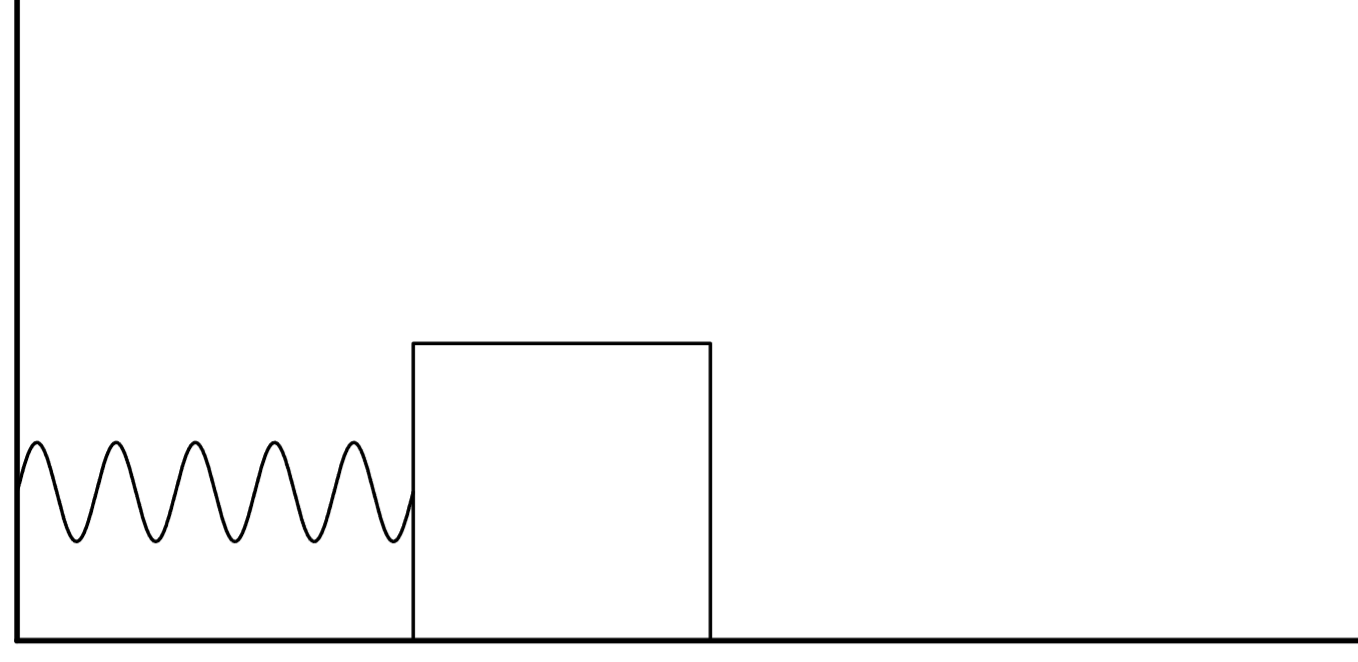
If we push the block towards the wall, compressing the spring, we’re storing elastic potential energy in the spring. When the spring is suddenly released, that elastic potential energy is converted to kinetic energy as the spring does work to push the block. This would start the block oscillating back and forth, but that part isn’t important for our present discussion. The point is that as the spring expands, it exerts a force on the block over a distance which causes the block to accelerate and gain kinetic energy.
Let’s examine the forces in more detail. The spring is initially under compression before we release the block. It is exerting a force on the block and an equal amount of force (in the opposite direction) on the wall. By Newton’s 3rd Law, the block and the wall each pushes back against the spring with an equal and opposite force. These two normal forces on the spring cancel each other out, leaving a net zero force on the spring (meaning it does not move).
Suppose the block is held in place with a bit of solid material that is attached to the wall. The block is also experiencing balanced compression forces from the spring and from the normal force of the stopper, but (assuming the block is inelastic) it does not deform like the spring. The stopper itself is being pushed to the left by the spring and to the right by the cube, creating internal tension forces (it is being “pulled apart” rather than “pushed together”).
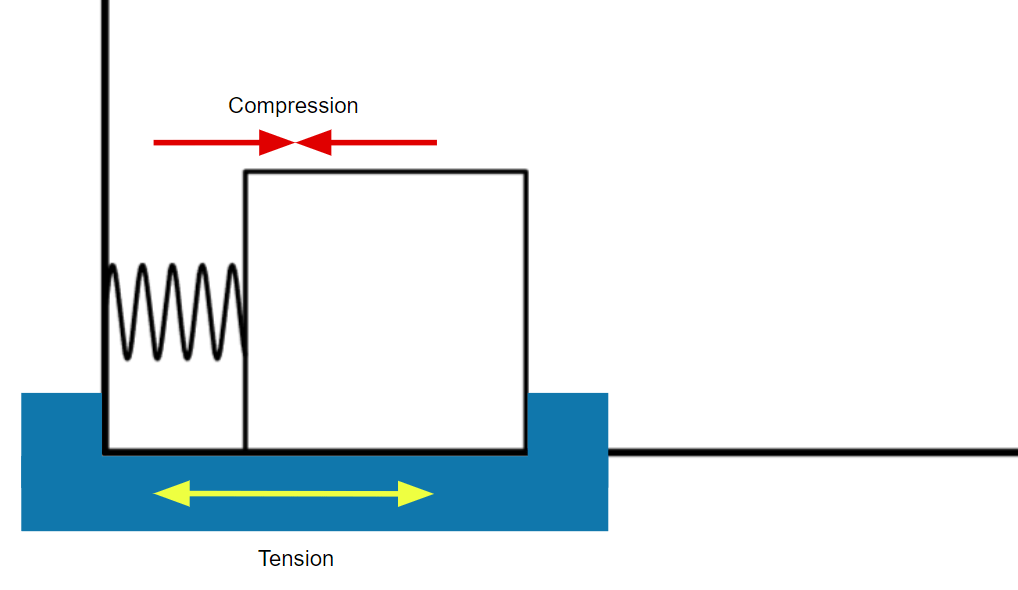
The forces on the stopper are in equilibrium, so it doesn’t move its center of mass, but what prevents the stopper from tearing in half under these forces? Well, it may tear itself in half if the spring is too strong for it, but otherwise it is opposing the forces from the spring and the cube (in accordance with Newton’s 3rd Law) with its intermolecular electromagnetic forces. These forces keep solid objects together.
Now, when the stopper is removed, the forces in the system will no longer be balanced. The force of the spring on the block is no longer opposed by force of the stopper on the block, so it accelerates according to its mass. As with the boat example, the spring is actually pushing the wall and the block apart, meaning that, if the wall is solidly anchored to the earth, the earth is also accelerated by a very tiny amount. The center of mass of the entire system does not move, and the total momentum of the system remains zero.
A bullet
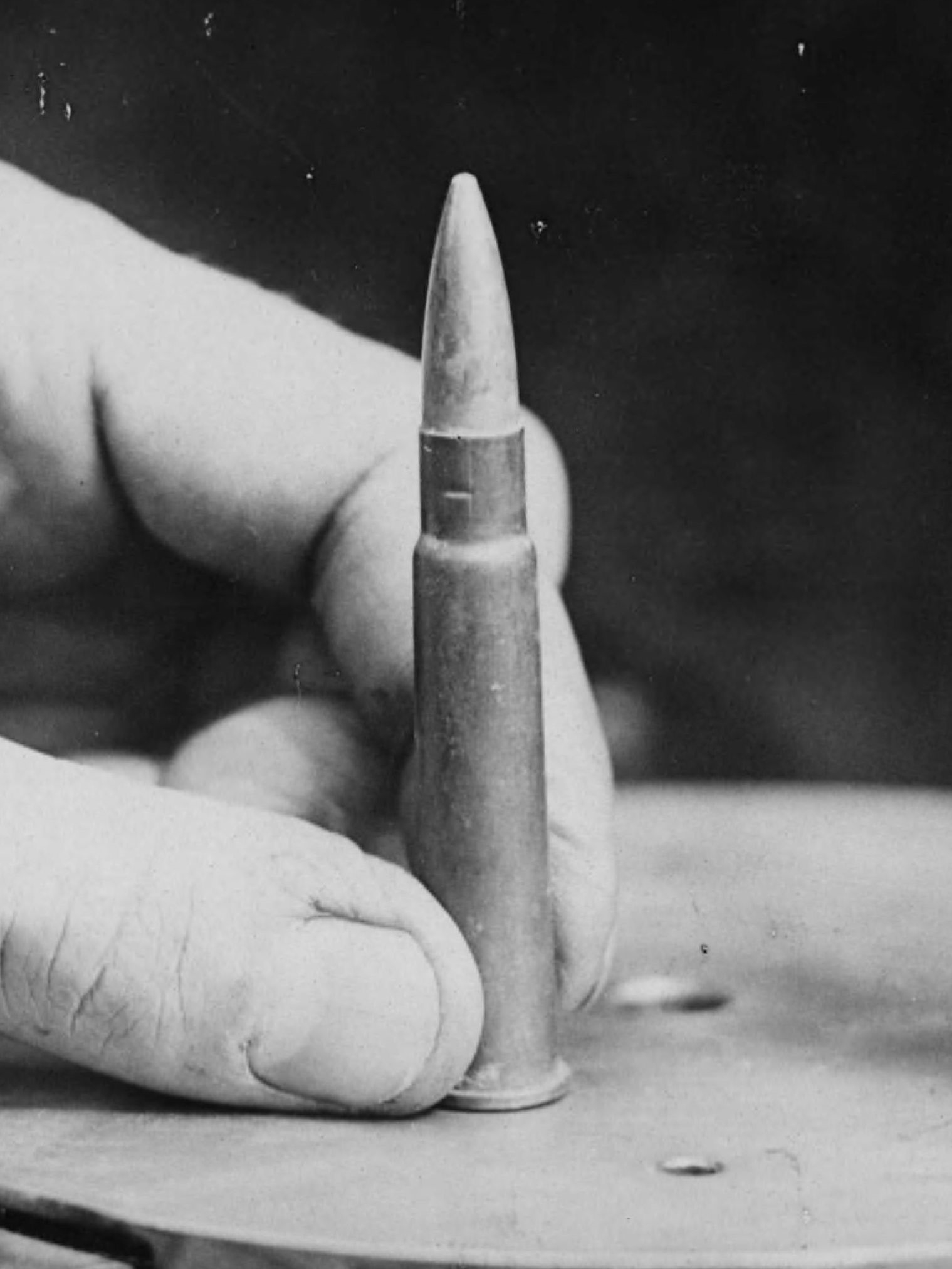
We want to talk about energy that comes from combustion, though. Let’s consider how a bullet is fired from a gun. A cartridge consists of a bullet, a casing, powder, and primer. Pulling the trigger causes the firing pin to strike the primer, igniting the powder. This creates a small explosion of hot gas behind the bullet. The pressure, far in excess of atmospheric pressure, forces the bullet down the barrel and out of the gun.
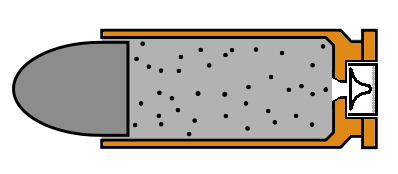
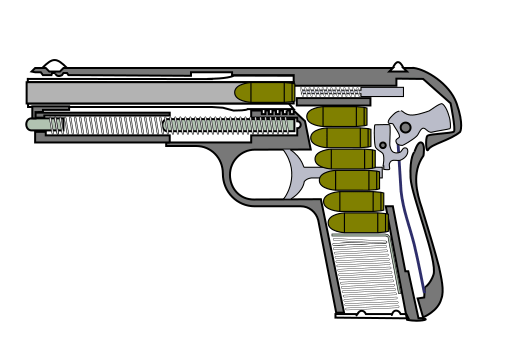

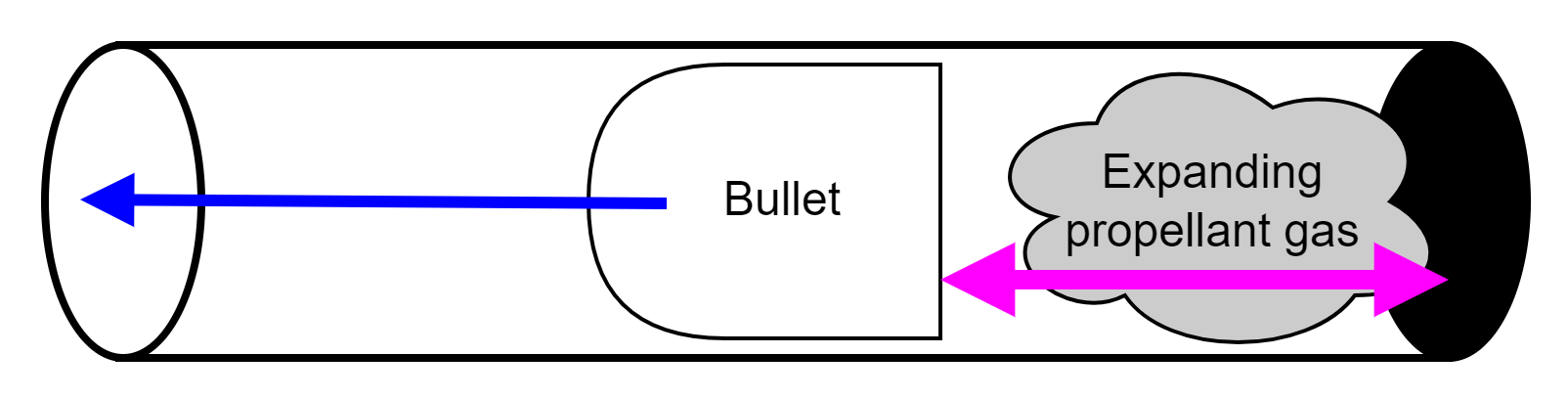
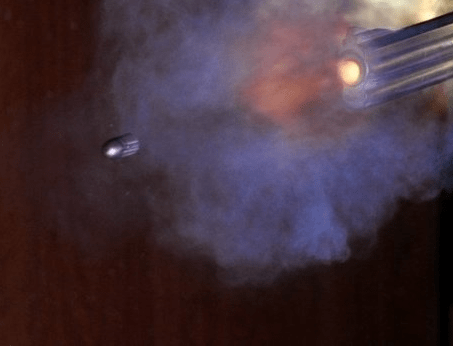
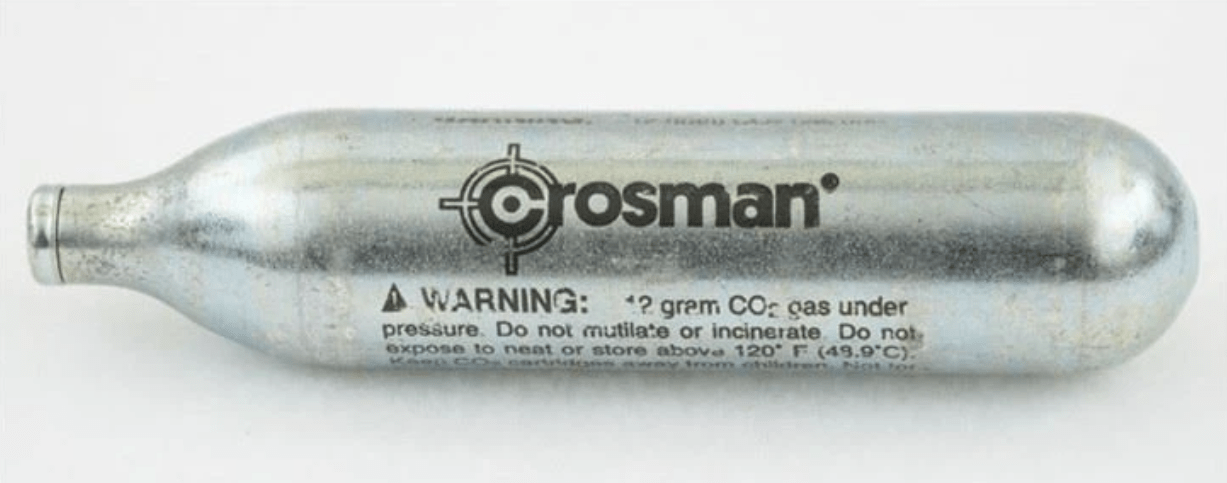
While the powder in a cartridge is not initially “compressed,” it has stored potential energy just like a spring (but this time it’s chemical potential energy). Alternatively, we could think of our situation as just starting with the compressed gas, which is very much like a spring (this is how airsoft guns work). The expansion of the gas pushes the bullet and the gun apart, launching the bullet forward and causing recoil for the person holding the gun. If the gun is firmly anchored to the earth, it will accelerate very little, with most of the energy going into the bullet.
All three examples described above work as follows. There is a pusher (arm, spring, gas), an object to be pushed (boat, cube, bullet), and a base attached to the earth (the dock, the wall, the gun). The pusher releases potential energy into kinetic energy (and, in the real world, heat energy, and possibly light and sound). It does this by doing work, and creates a pair of equal and opposite forces, one on the object and the other on the base. Each of these creates a normal force on the pusher, causing internal compression forces. Since the same magnitude force is applied to both the object and the base, but the object to be pushed has comparatively far less mass, it accelerates much more in accordance with Newton’s 2nd Law. At any point during this process, the momentums of the object and base must be balanced (i.e. equal and opposite) but almost all the energy goes into the object being pushed.
Moving by losing mass
Now, let’s think about how we could move something without pushing off of a “stationary” surface. We will still utilize Newton’s 3rd Law, but this time we will create an acceleration by jettisoning an object. Imagine a cart on wheels with little to no friction. If we sit on the motionless cart with a heavy bowling ball, then forcefully toss the bowling ball away, the equal and opposite force will start us rolling in the opposite direction. We can also think of this in terms of conservation of momentum: if the momentum of the entire system is initially zero, then whatever momentum we give the bowling ball must be canceled out by the momentum of us sitting on the rolling cart.
Or, we can think of this in terms of conservation of energy. This is a little more complicated. We exert force on the ball over a distance, doing work on it. This converts chemical potential energy in the body into kinetic energy. In previous examples, however, one part of the system (what I called the “base”) was moved by such a small amount that we treated its energy as negligible. Here, each of the two parts (the cart and the ball) move a nontrivial distance. Notably, the kinetic energy of each part increases, but not by the same amount.
It will be a little easier to think about, I think, using an idealized setup of a marble fired from a gun on wheels. Let’s suppose that, when fired, a valve releases pressurized gas so as to apply a constant force on the marble until it leaves the barrel. Note that for an ordinary spring or bullet, the force actually decreases as the spring/gas expands, which makes calculations more complicated. Additionally, we will start out with the marble resting directly over the center of mass of the gun.
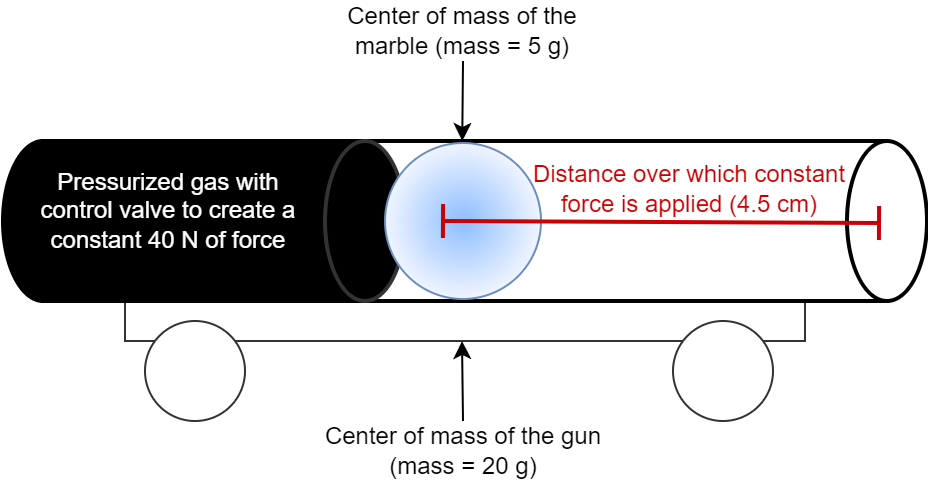
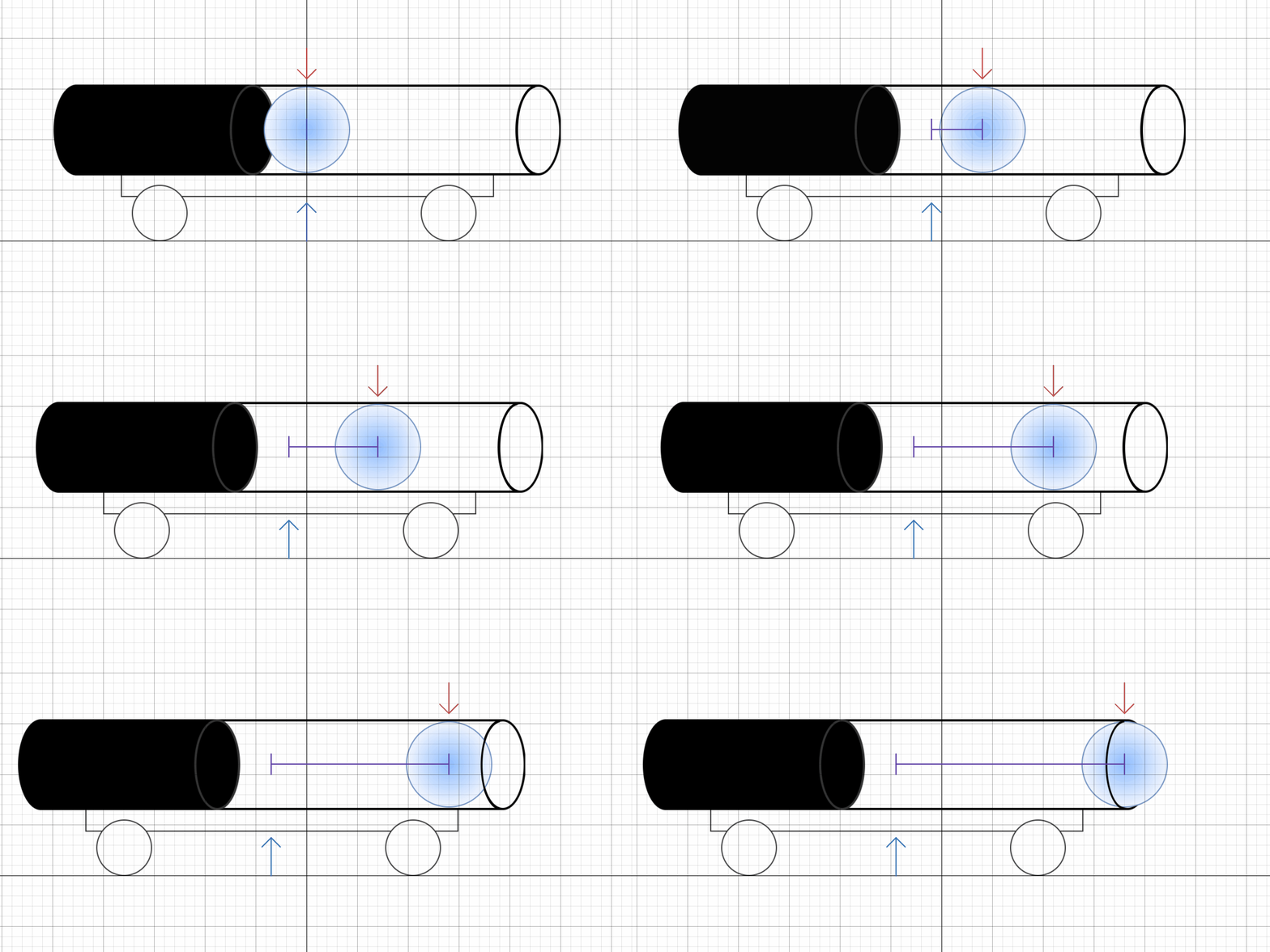
This is fundamentally the same kind of situation as we saw before, but now the two objects in the system have much closer to the same mass. What we see is that, as the gas pushes the gun and the marble apart, they each move an appreciable amount from their starting position. Since the marble has less mass, the same force gives it greater acceleration, so it moves farther than the gun in the same amount of time. Thinking about work, the distance over which the marble is pushed is not the total distance it moves through the barrel, but rather its displacement from its starting position, which is less since the gun is simultaneously moving away from it.
So the pressurized gas is doing work on both the marble and the gun, and exerting the same amount of force on each, but over different distances. The shorter distance the gun moves means less work is done on it, so its final kinetic energy is less.
Let’s do some math. I’ll write subscript 1 for the marble and subscript 2 for the gun. We know the following:
Masses: m1 = 0.005 kg and m2 = 0.02 kg
Forces: F1 = 40 N and F2 = -40 N (negative denotes a leftward direction)
Time: let’s say it takes 3 milliseconds to fire, or t = 0.003 s.
Now, we can calculate accelerations using Newton’s 2nd Law written as a = F/m:
a1 = F1/m1 = 40 N / 0.005 kg = 8000 m/s2
a2 = F2/m2 = -40 N / 0.02 kg = -2000 m/s2
We can calculate velocity using v = at:
v1 = a1t = 8000 m/s2 × 0.003 s = 24 m/s
v2 = a2t = -2000 m/s2 × 0.003 s = -6 m/s
Next, find distance using d = ½at2:
d1 = ½a1(t1)2 = ½ × 24 m/s × (0.003 s)2 = 0.036 m
d2 = ½a2(t2)2 = ½ × -6 m/s × (0.003 s)2 = 0.009 m
Let’s quickly verify that the momentums are equal and opposite with P = mv:
P1 = m1v1 = 0.005 kg × 24 m/s = 0.12 kg × m/s
P2 = m2v2 = 0.02 kg × -6 m/s = -0.12 kg × m/s
That checks out. Now let’s find kinetic energy with KE = ½mv2:
KE1 = ½m1(v1)2 = ½ × 0.005 kg × (24 m/s)2 = 1.44 J
KE2 = ½m2(v2)2 = ½ × 0.02 kg × (-6 m/s)2 = 0.36 J
And finally, let’s compare the kinetic energy values to work W = Fd:
W1 = F1d1 = 40 N × 0.036 m = 1.44 J
W2 = F2d2 = -40 N × -0.009 m = 0.36 J
Note that I’m using × to denote scalar multiplication here and not vector cross product.
So what’s the upshot of all this? We can see that pushing off from the earth is the same situation as the marble gun and indeed the same as throwing a bowling ball from a cart. The difference is only that the earth is extremely massive. In fact, the greater disparity in mass between the two objects involved, the greater disparity there will be in their resultant kinetic energies, with the less massive object gaining more kinetic energy than the more massive object. Specifically, these two quantities (mass and kinetic energy) are inversely proportional. In the marble gun example, the ratio of the mass of the marble to the mass of the gun is 1:4, and the ratio of the kinetic energy of the marble to the kinetic energy of the gun is 4:1. Intuitively, this is because kinetic energy depends more on velocity than it does on mass, and less mass means more acceleration with the same force. In short, it’s easier to move a pebble than a boulder.
This means that, if we only really care about moving one of the two objects involved (with the movement of the other object essentially being a necessary byproduct), then we would want the object we’re trying to move to have the lesser mass by a long shot. Or, if that is not possible, we would want the masses to at least be as close to equal as possible.
Finally, rockets
Let’s talk briefly about how rocket propulsion works. A rocket requires both fuel and oxygen (or an oxidizer, something that provides oxygen), which can be liquid or solid. We’ll use liquid fuel rockets as an example here. Solid fuel rockets work in basically the same way, but the details are different. As always, our example will be simplified in order to focus on the parts we’re currently interested in understanding.
Inside a rocket like this there is a tank for fuel, a tank for the oxidizer, and a combustion chamber where the two combine and the mixture combusts. With oxidizer, the fuel can burn efficiently and without the need for oxygen from the air. The chemical reaction of fuel molecules combining with oxygen releases a huge amount of heat from the chemical potential energy in the fuel. Because of this dramatic rise in temperature, the now-combusted fuel and oxidizer (which can just be called propellant at this point) rapidly and forcefully expands. There is only one exit from the combustion chamber, which is through the nozzle of the rocket. Once the propellant leaves the rocket, it is exhausted (used up; no longer useful) which is why the smoke coming out of a rocket engine is called exhaust.
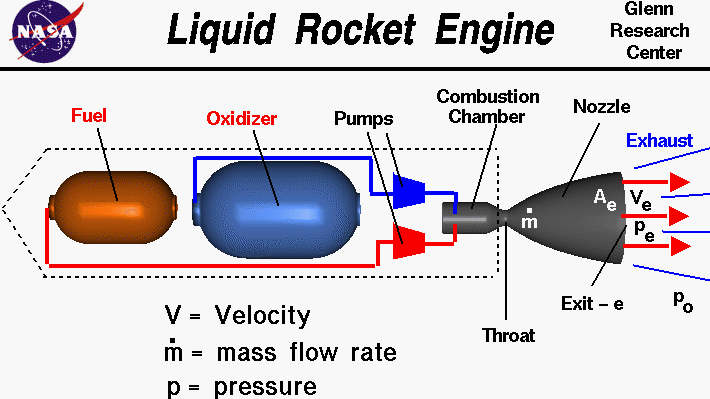
Since we have done so much prep work to get here, you may already see where this is going. I want to make a couple minor points first. For one, keep in mind that the hot propellant gas exerts pressure in all directions (though not equally in all directions in this case). In particular, the propellant exerts a force on the walls of the combustion chamber which also exert a normal force on the gas. Similar to the spring example above, this places the gas under compression and the walls of the chamber under tension. If the walls of the combustion chamber are not strong enough, the intermolecular forces will not be able to balance the force of tension and the chamber will rupture explosively. Note that gas does not have these intermolecular electromagnetic forces since the molecules are free-floating and not right next to one another. As a result, it is not possible to get tension forces in a gas under any ordinary circumstances. “Negative pressure” only exists in relation to another, greater pressure. Gas also does not compress in the same way a solid might; while two solid objects can be directly adjacent without exerting hardly any force on each other, gas must exert a pressure (force applied over an area) on virtually any solid or liquid surface it is in contact with. Gas pressure has to do in part with the temperature of the gas, i.e. the average kinetic energy of individual gas molecules as they move around. Adding heat to a gas increases its temperature, meaning the molecules are moving faster and colliding more forcefully with any object they come into contact with. In an open space, heated gas increases in volume as the molecules quickly become dispersed (this is Charles’ Gas Law from high school chemistry).
Second, a note about fluid dynamics. Remember that a fluid is anything that acts like a fluid, not necessarily liquid. One of the most important laws in this area is Bernoulli’s principle, which relates pressure, cross-sectional area (which we can think of as diameter of a pipe), and velocity. I won’t go into detail on it here. The part that I want to note is that, in our rocket engine situation, the diameter of the nozzle’s “throat” affects the velocity of the propellant. In short, if you want to force the same amount of stuff through a smaller pipe, it has to move faster. In terms of energy, the gas behind the throat is doing work on the gas in the throat to increase its kinetic energy. Pressure is also involved here, and remember pressure is ultimately also due to kinetic energy, but we won’t go any farther into the weeds with this.
How rockets actually accelerate
So, the rocket starts out with zero momentum and zero kinetic energy, but loads of potential energy in the form of fuel. When the fuel burns, it does work to increase the kinetic energy of the resulting propellant gas (as temperature and pressure). The pressure of the gas exerts forces in all directions. Around the sidewalls of the combustion chamber, there are balanced tension and compression forces. In the direction of the nozzle, however, there is no wall to provide that same normal force, and the forces are not balanced. The propellant does work on (a different part of) itself and rapidly accelerates through the throat and out the nozzle. The propellant is serving two purposes here, being both the earth and the arm, the earth and the spring, the earth and the gunpowder, the marble gun and the pressurized gas. The body of the rocket, then, is the boat, the block, the bullet, and the marble.
As we saw in all those examples, what happens is a pushing apart, where the momentums must be equal and opposite and the kinetic energies differ according to mass. The rocket is complicated a bit by gradually losing mass through exhaust as work is done on it. A rocket is most difficult to move when it is full of fuel. As mentioned earlier, the ideal situation would be for the mass of the “base” (propellant) to far exceed the mass of the object being propelled. That is difficult for a rocket, not least in part because the rocket must initially contain the mass of the propellant within itself. Rockets suffer from inefficiency since much of the energy from the fuel is wasted on fast-moving exhaust (i.e., inefficiency due to the difference in how the kinetic energy is distributed between the rocket and the exhaust). This is not even to mention the fact that, when launching from the earth, it has to also overcome the force of gravity, with the rocket being heaviest when full of fuel. As a result of all this, rockets are most efficient when they can rapidly expend their fuel, losing a great deal of mass in a short amount of time.
In order to create such an extreme lift force, rockets must contain huge quantities of dangerous fuel and withstand brutal temperatures and pressures. This is a major part of why rocket science, or more accurately rocket engineering, is such a notoriously challenging field. While very small rockets like fireworks are easy to make and have been made by humans for hundreds of years, large rockets made of heavy materials are difficult to get off the ground at all without exploding. Getting a rocket to escape velocity so it can travel to, say, the moon, is incredibly difficult, not to mention the aeronautics and many complex systems required in addition to merely getting up to speed. Rockets may seem almost commonplace nowadays, especially with their frequent use in missile systems. It may even seem like it is easy to build rockets now, but doing things like getting a satellite into orbit could only seem easy in retrospect now that many hundreds of people have been working very hard for many decades to solve these problems.
And yes, the title of this post is a trick question. TL;DR rockets push against their own burned fuel. More accurately, nothing moves by pushing against a stationary object, things can only ever be pushed apart. Our intuition from dealing with the earth, which is incomprehensibly more massive than ourselves, is misleading.
 thoughts on mind