
Are there undefinable numbers? Numbers that exist, but that we can’t identify or talk about? According to one argument, there must be such numbers, since there must be more numbers than definitions.
Preliminaries
First, some background about infinity. We’ll start by talking about the foundations of math using set theory.
A set is an unordered collection of distinct elements. We write it like {a, b, c}.
Two sets have the same cardinality if their elements can be put into one-to-one correspondence.
If a set has a finite number of elements, then its cardinality is the number of elements it contains. Otherwise, its cardinality is infinite.
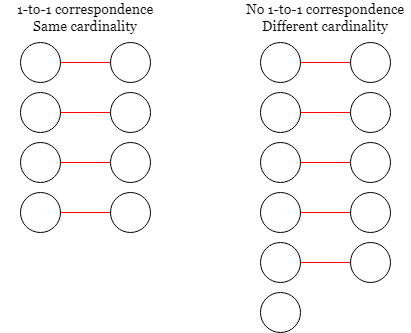
The natural numbers refers to the set { 1, 2, 3, 4, … }, aka the counting numbers.
The real numbers refers to the set of all decimal numbers with any number of digits (or infinitely many digits). This set contains all the integers, rational numbers, and irrational numbers.
The natural numbers and the real numbers both have infinite cardinality. However, in order to show that they have the same cardinality, we must be able to put them into a one-to-one correspondence. Spoiler alert: it turns out this is impossible. This means that not all infinities are the same; some infinities are bigger than others.
We can prove that making a one-to-one correspondence between the naturals and the reals is impossible as follows.
Cantor’s diagonal proof
This is a proof by contradiction. We’ll start by assuming the opposite of we want to prove, then we’ll show that that assumption leads to a logical contradiction, and therefore must be impossible.
Assume we can make a one-to-one correspondence between the natural numbers and the real numbers. This is equivalent to being able to list out all the real numbers on an infinitely long, numbered list. The order that the real numbers are listed in does not matter. So suppose we have something like this:
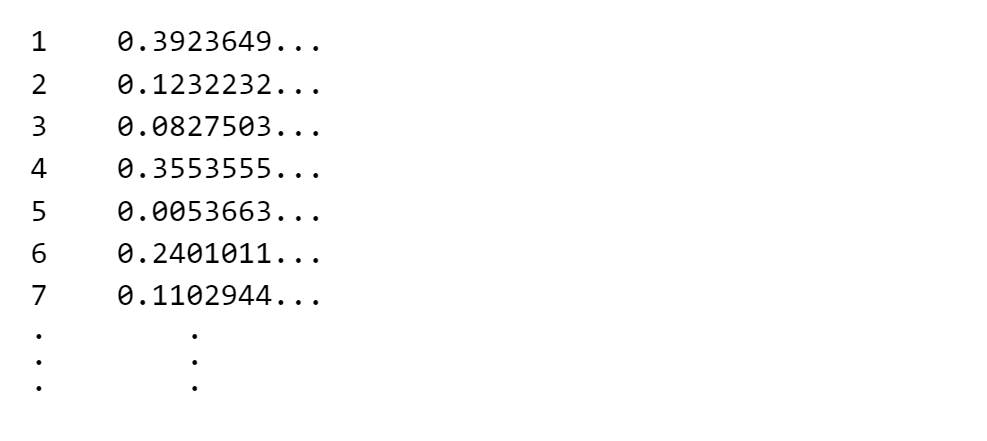
This list must be comprehensive according to our assumption. If we can find a real number that is guaranteed not to be on the list, then that’s a logical contradiction. That would show our initial assumption must be impossible.
We’ll construct a real number not on the list like this: for the first digit after the decimal point, look at the first digit of the first number on our list and subtract that number from 9. In our example that’s a 3, so our number has a 6 after the decimal point. For the second digit, take the second digit from the second number and subtract it from 9. We get 9-2=7. Next, take the third digit from the third number and subtract it from 9. Continue on like this for all infinitely many digits.
Let’s imagine a challenger appears and claims that our number is on the list. Then it must be some number on the list, say n. But it can’t be the nth entry on the list, because its nth digit after the decimal point differs from the same digit of the nth entry! If the nth entry’s nth digit is some number k, then our number’s nth digit is 9-k. If it’s 1200th on the list, and the 1200th digit of that entry is a 4, then our number’s 1200th digit must be a 5, and therefore not the same as the 1200th entry on the list. At every entry in the list, we’re guaranteed that it’s not our number, since by definition there is a corresponding digit that must be different.
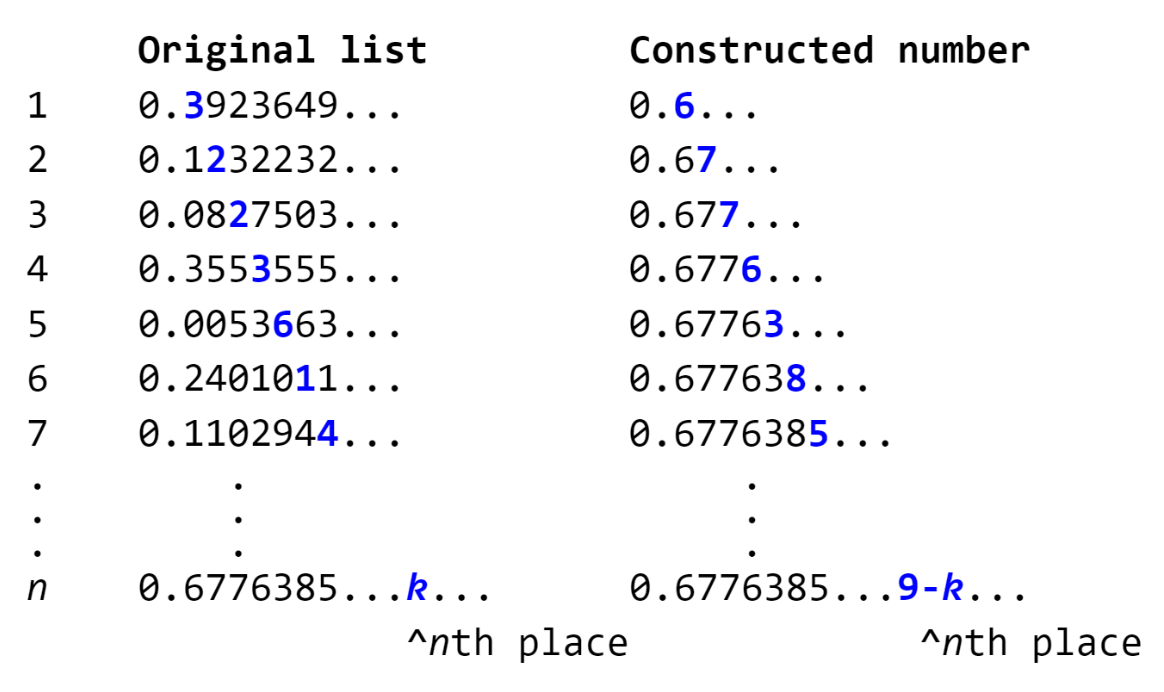
Thus the number we cleverly constructed must not be on the list, however we started by assuming all numbers are on the list. This is a logical contradiction, and so it must not be possible to make a one-to-one correspondence between the natural numbers and the real numbers. This means that they cannot have the same cardinality, despite both being infinite. Since cardinality lines up with our intuitive notion of “size” for finite sets, this proof establishes the existence of “different sized” infinities. Sets that have the same cardinality as the natural numbers are referred to as countable or countably infinite. Sets like the real numbers that have a larger cardinality than the natural numbers are referred to as uncountable or uncountably infinite.
Math tea
“One sometimes hears a certain philosophical argument, which I have called the math tea argument … for it might be heard in the contemplative discussions at a good math tea”
Hamkins 2022
How can numbers be named, described, or defined? The most obvious answer is a decimal (or binary, or hexadecimal, or other base) representation. Something like “38,801.2240055621” is a string of symbols that uniquely picks out a specific real number. Note that not all real numbers can be represented perfectly this way. The number π, an irrational number, cannot be uniquely picked out by a finite string of decimal digits. Something like “3.14…” is insufficient to actually specify π. This is the reason for representing it with a special symbol, which is mathematically defined to be the exact value. This problem applies to all irrational numbers, for example √2 is written the way it is (“unsimplified”) because it is irrational and cannot be represented exactly by decimals.
Real numbers can also be described or defined in words. “The number of vertices on a dodecahedron” uniquely picks out a real number. However, we have to be careful with this, because English allows the construction of sentences that don’t make mathematical sense. Additionally, some sentences may rely on the truth or falsehood of unproven conjectures. In other words, a sentence that sounds like it uniquely describes a number may not in fact do so. The meaning of the sentence matters.
So, to summarize how we can name, identify, or define real numbers:
- Decimal representation such as -500 (or fractions of decimals)
- Special symbol such as π or e
- Result of a function such as √2 or log(3)
- Verbal description
Note that each of these representations consists of a finite strings of symbols. We as humans can only write finite strings. Let’s think about what numbers we’re capable of describing. Clearly we can name every rational number using decimals and fractions. For irrational numbers, we must rely on the other strategies. We can certainly name a lot of irrational numbers, but could we name all of them, even in principle? In other words, can we name every real number?
The math tea argument says no. No matter how many different symbols we use, the possible number of finite strings of symbols is only countably infinite. The real numbers are uncountably infinite. Not only does this imply that there are real numbers that humans can’t talk about, but also it implies that this is the vast majority of real numbers. The continuum of real numbers, then, is a background of anonymous, inaccessible numbers with a small sprinkling on top that consists of all real numbers humans could ever talk about even in principle. This result may seem startling. What are these mysterious numbers? Do they even meaningfully exist if we can’t identify them in any way?
Taking a critical look at the argument
The argument above may be convincing, but it is not a proof. First of all, we were imprecise about exactly what a “verbal description” is. We just kind of gestured vaguely at the fact that some English sentences can pick out numbers. One idea is that a sentence picks out a number if it gives us enough information to list out indefinitely many of its digits. This is more or less the definition of the computable numbers: numbers for which there exists an effective algorithm for listing out their digits. However, we can identify non-computable numbers, notably for example Chaitin’s constant Ω.
Ω is not a single number, but rather a class of non-computable irrational numbers. Without going into too much detail, it is a number associated with computer algorithms. The number is non-computable because creating an algorithm that lists out the number’s digits is equivalent to solving the halting problem.
The basic idea of the halting problem is this: it is impossible to write a computer program that is capable of taking any other arbitrary program as input and telling you (reliably) whether that program will eventually terminate (“halt”) or if it will loop infinitely. In essence, having all the digits of Ω is equivalent to having such an impossible program. That being said, it is possible to compute a finite number of digits of Ω. So such a number is not totally unidentifiable, and in principle we could list out as many digits as we wanted.
Consider the similarity and difference between Ω and π. In addition to being irrational, they are both transcendental numbers, meaning they are not the root of any polynomial or rational equation. Since π is a computable number, we can create an algorithm that outputs all the digits of π, given infinite memory and time. This is not possible for Ω. However, no actual computer has infinite memory or computing time, so it is only possible in fact for humans to list out a finite number of digits of π. This leaves Ω and π with the same status in this regard, despite the difference in computability. Granted, to say that the digits of Ω are significantly more difficult to calculate would be an enormous understatement, so it is not as if the non-computability of Ω is a trivial in-principle-only distinction. No one has calculated more than a few digits (relatively speaking) of any particular instance of Ω.
Now, what does this have to do with the math tea argument? It turns out that deciding what counts as a definition/specification of a number is a counterintuitive problem. Going back to the foundations of math, we usually think of “ordinary” math as supposedly taking place within a formal set theory such as ZFC (Zermelo–Fraenkel set theory with the axiom of Choice). There is a field called mathematical logic that studies these formal set theories themselves, and within this context we can talk about definability in a much more precise way.
Theories and models
In mathematics, a formal theory consists of axioms (statements that are assumed to be true) and logical rules of inference by which additional statements can be proven.
A model for a theory is an actual mathematical structure that fits the theory like a blueprint.
Example: Robinson arithmetic
Robinson arithmetic is a theory of first-order logic with equality (=). It has a constituent set whose members we will call numbers, with a distinguished member denoted 0. It has one unary operation, the successor function denoted S, and two binary operations, addition and multiplication, denoted + and * respectively. Informally, the successor function gives you the next counting number.
Axioms:
- 0 is not the successor of any number.
- ∀x S(x) ≠ 0
- If two numbers have the same successor, then those two numbers are the same.
- ∀x,y S(x) = S(y) → x = y
- Every number is either 0 or the successor of some number.
- ∀x x = 0 ∨ ∃y S(y) = x
- Definition of addition:
- ∀x,y x+S(y) = S(x+y)
- 0 is the additive identity.
- ∀x x+0 = x
- Definition of multiplication:
- ∀x,y x*S(y) = S(x*y)+x
- 0 multiplication property:
- ∀x x*0 = 0
This theory consists of a collection of statements (theorems) and proofs. The standard model of this theory is the natural numbers with a simple form of arithmetic (also called Peano arithmetic).
Note that I said standard model. For any theory, there is typically a standard model which is informally considered “canonical” but there may be additional nonstandard models. Many theories have infinitely many different models.
Models of ZFC
As mentioned previously, ZFC is the most commonly used set theory, and it serves as the foundation for “ordinary” math. Therefore, when we talk about the real numbers, we often assume to be talking about a model of ZFC. If we were to formalize theorems about real numbers, ZFC is the theory that the theorems would be part of. ZFC obviously has more to it than this, but for our purposes we can talk about models of ZFC just in relation to real numbers.
We are getting to the point of why we needed to talk about theories and models. In this context, the “definition” of a number can be described as a logical statement within a theory.
A model in first-order logic is pointwise definable if every individual is definable in the model without parameters—every individual has an expressible property that only that individual has. A pointwise-definable model is thus completely determined by its theory, the set of sentences true in that model, for the existence of the definable elements and their atomic structural features, including the manner in which they relate to one another, are all to be found as particular assertions in the theory. One can thus reconstruct an isomorphic copy of the model using only the syntactic information in the theory.
Hamkins 2022
The punchline is that ZFC has pointwise definable models, in fact it has infinitely many non-isomorphic (i.e. genuinely different) pointwise definable models (Hamkins et al. 2013). This means that there are models of ZFC in which every real number has an expressible property that only that number has and by which it can be uniquely identified.
In a pointwise-definable model of Zermelo-Fraenkel ZFC set theory, after all, the real numbers form an uncountable set, since this is a theorem of ZFC, and yet every real number, every function, every topological space, every set altogether, is uniquely characterized in such a model by some defining set-theoretical property. The existence of pointwise-definable models of set theory thus reveals that one cannot undertake the math tea argument as an ordinary mathematical argument, one formalized in ZFC, for then it should work even in such a pointwise-definable context, but it cannot since every real number is definable in such a world. The math tea argument thus must take place outside mathematics, a metamathematical argument engaging with the ineffable nature of definability.
Hamkins 2022
The trouble with theories
So, what is the upshot of all this? There are a few things going on here that make this situation confusing (beyond the fact that it involves math). The first is that computability (being able to list out digits) seems to fit our understanding of what it means to identify a number, but this turns out to be an incorrect assumption, which makes things more complicated. Second, if we try to use a set-theoretic formalization of definability, we find that the math tea argument doesn’t work. In other words, “there are uncountably many reals but only countably many definitions, therefore there are undefinable reals” is not a valid theorem of ZFC (if ZFC is consistent).
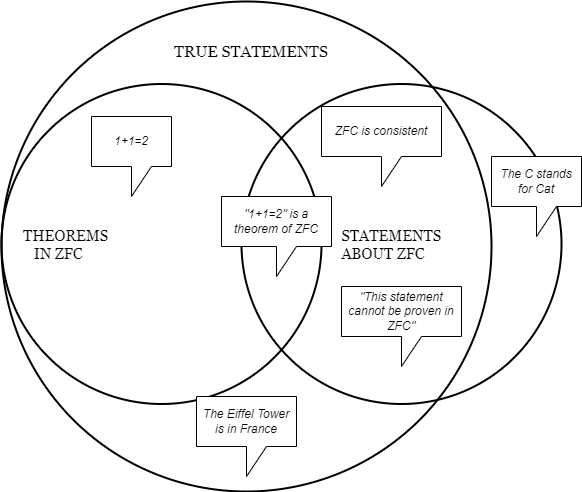
Why if ZFC is consistent? This gets to the heart of what is confusing about such formal theories. It is critical to distinguish between statements within the theory and statements about the theory. Perplexingly, many statements about the theory are expressible within the theory itself, and in fact every formal theory of real-number arithmetic is self-referential. This ends up causing problems.
First, some definitions:
A theory being complete means every true statement can be proven from the axioms. If it is incomplete, then there exist true statements that cannot be proven.
A theory being consistent means every statement that can be proven from the axioms is true. If it is inconsistent, then there exist false statements (i.e. contradictions) that can be proven.
Gödel’s Incompleteness Theorems
In a system like ZFC, it is possible to construct a statement like “This statement cannot be proven in ZFC.” This is called a Gödel sentence, and it creates a paradox: if the statement is true, then it is an unprovable true statement and ZFC is incomplete; if the statement is false, then it can be proven, making something false provable and thus making ZFC inconsistent. As a result, ZFC cannot be both consistent and complete. Moreover, it is impossible for ZFC to prove its own consistency if it is consistent. It is technically unknown whether ZFC is consistent or not, though it is generally assumed to be.
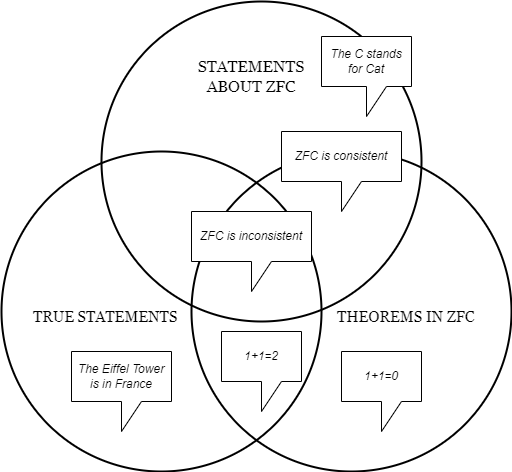
Why is everything provable if ZFC is inconsistent?
In short, everything follows from a contradiction. The reason is because of disjunction introduction and disjunction elimination, two rules of inference in logic.
Disjunction introduction works as follows. If we have any statement P, then we can infer the statement P or Q for any other statement Q. For example, if it’s true that it’s raining, then it’s also true that it’s raining or I own a unicorn.
With disjunction elimination, we start with a statement like P or Q. Then, if we can establish that P is false, we can infer Q. For example, if it’s true that it’s raining or I own a unicorn, and I know I don’t own a unicorn, then I can infer that it’s raining.
Now, a contradiction is essentially a statement that is necessarily false. Suppose X is a contradiction we have somehow inferred. We can use disjunction introduction to infer X or Y for any other statement Y. But since X is false, we can then use disjunction elimination to infer Y. Similarly, we could infer X or not Y which then yields not Y. In other words, the contradiction X proves both Y and not Y for any statement Y.
Therefore, if ZFC is inconsistent, then any statement that can be expressed in the language of ZFC can be proven in ZFC.
Assessing math tea in summary
The math tea argument gets at some of the most essential and intractable questions about the nature of mathematical proof. Under many circumstances, informal reasoning is sufficient to solve mathematical problems. Making statements about what math is capable of, though, is notoriously fraught and unintuitive. In the case of math tea, Hamkins argues that it can only possibly work as a philosophical argument, and in particular it is not something we could prove.
There is an alternative approach to the math tea problem, one which I foreshadowed by comparing Ω and π. Even though we can create algorithms that theoretically output “all” the digits of π, to do so in practice would require infinite time and energy. The statement that only countably many real numbers can be defined or represented is a trivial consequence of the fact that only finitely many real numbers can be defined or represented, if we interpret this as an action and not as an abstract property of numbers. After all, any action takes some amount of time, and humans (presumably) only have a finite amount of time to exist as a species. In other words, in practical terms the math tea argument is trivially sound and therefore not really worth considering. We will never know or be able to talk about the vast majority of real numbers, in fact we will never be able to talk about the vast majority of natural numbers either. So what we see here is an argument that can be interpreted in different contexts, and works (or fails to work) differently in each.
From a philosophy of math perspective, math tea relates to the nature of the continuum, which is a historically controversial topic. In the Intuitionist philosophy of math for example, math is regarded as an empirical study of mental constructions. As a result, this philosophy admits only constructive mathematics: no object can be legitimately proven to exist unless it can actually be constructed. This has some important consequences for infinity. Looking at the natural numbers, it is always possible to construct a larger number, but it is not possible to construct the whole of the natural numbers. As a result, the cardinality of the natural numbers is regarded not as an “actual” infinity, but rather a “potential” infinity. Regarding the real numbers, for Intuitionism the diagonal proof shows that the real numbers as defined actually fail to form a set. Thus for the Intuitionist no numbers exist which cannot be mentally constructed in some way. Note that since Hamkins’ proof is not constructive, it would be rejected under Intuitionism.
Intuitionist mathematics is too limiting for most mathematicians. I am sympathetic to the Intuitionist’s ontological perspective, but it’s not very pragmatic. Historically, others outside the Intuitionist camp have also taken issue philosophically with the notion of larger infinities or with infinity in general. Despite our apparent ability to prove theorems about it, it is not clear whether infinity is a philosophically coherent concept.
Okay, but what’s the answer?
In short, the question is ill-formed. It is at best insufficiently specific, and at worst it conflates multiple different meanings of definability. The math tea argument is most interesting to me as an example of something that appears obviously true but breaks down when you look at it more closely. This happens a lot in math, especially in foundations of math. There is a well-known quote from Jerry Bona: “The axiom of choice is obviously true, the well-ordering principle obviously false, and who can tell about Zorn’s lemma?” The joke is that these three statements– the axiom of choice, the well-ordering principle, and Zorn’s lemma –are all logically equivalent to one another, in other words they are essentially saying the same thing in (very) different ways. Math is sometimes highly counterintuitive; things that seem at first obviously true can turn out to be false and things that seem obviously false can be true. As in all areas of belief, it is important to avoid credulity and remain skeptical even in the face of apparent certainty.
Explaining the joke in more detail
- The axiom of choice
Imagine several boxes, each containing a pair of shoes. Suppose we want to form a set that contains one shoe from each pair. This is very easy, as we can simply go through each box and pick one shoe from each one. Now, imagine we have infinitely many boxes, each containing a pair of shoes. Can we still form a set containing one shoe from each pair? Yes, for example by stating we will take the left shoe from each box. With this definition, for any particular box we select, we can tell without looking which shoe is in our set, a clear sign that the set is well-defined.
Now imagine that we have some boxes each containing a pair of socks. With only finitely many boxes, we can again go through one by one and identify a sock from each pair that will be in our set. However, if we have infinitely many such boxes of socks, can we still form a set containing one sock from each pair? We can’t use the same solution we used for shoes, because left and right socks are indistinguishable. What we can do is say we will pick one sock from each pair arbitrarily. But does this legitimately form a set?
It turns out this is a more difficult question than it may seem. The standard axioms of set theory, if consistent, cannot answer the question either way. The axioms are consistent with both a “yes” and a “no.” As a result, we can create two different versions of set theory, one in which we specify the answer as “yes” and one in which we specify the answer as “no.” The axiom of choice is what we add to set theory in order to specify a “yes.” It says it is possible to form a set in this way. The two set theories are ZF with the axiom of choice (“ZFC”) and ZF without the axiom of choice (“ZF”). (Technically, there is a difference between ZF without C and ZF with the negation of C, but that’s not important here.)
The axiom of choice may seem obviously true to some in part because it enables us to talk about arbitrary functions, which intuitively seems like something we ought to be able to talk about. Some have philosophical objections to this axiom because it has some highly counterintuitive results, such as the Banach-Tarski paradox (in which a ball can be cut up in such a way that the pieces can be reassembled to two balls each the same size as the original one).
- The well-ordering principle
An ordering of a set is a relation between elements of the set that enables us to arrange the elements in order. For example, the real numbers are an ordered set using the relation < (less than). For any two different real numbers, we can always tell which one comes first in the ordering.
A well-ordering of a set is a stronger property. Not only must the set be ordered, but also each element must have a “next” element in the ordering. For example, the natural numbers are a well-ordered set using < because the next number in the order can be acquired by adding 1 to the current number.
The well-ordering principle states that any set can be well-ordered, including uncountable sets such as the real numbers. Note that the real numbers cannot be well-ordered using <, since there is no next-larger real number (since between any two real numbers there are always infinitely many more real numbers). In other words, the well-ordering of the real numbers must be some other (unknown) order. The well-ordering principle doesn’t help us figure out the order, it simply states that it is possible.
Regarding the well-ordering principle seeming obviously false, recall that the real numbers cannot be listed out, as we saw above. In fact, even the nonnegative real numbers (greater than or equal to zero) cannot be listed out in this way. This seems intuitively to contradict the idea that the real numbers can be well-ordered. Why can’t we put zero as the first item in the list, then have each subsequent item be the next real number in the ordering? Despite this apparent contradiction, the two concepts are not in fact equivalent. The real numbers can be both well-ordered and uncountable.
- Zorn’s lemma
Zorn’s lemma involves partial ordering. So far we have been talking about total orderings, that is, a single ordering relation that applies to an entire set. Sets may also have partial orderings, where some elements can be compared and placed in order relative to each other but other elements cannot. For example, consider street addresses. We can say 302 Oak St comes before 304 Oak St, but we can’t straightforwardly determine which comes first between 302 Oak St and 302 Maple St. In other words, we can order houses on a street, but we can’t order houses from different streets. This is a partial ordering.
We also need to define the idea of a chain, an upper bound, and a maximal element. A chain is a subset that is totally ordered, for example all the addresses on Oak St could form a chain. An upper bound is an element that is greater than or equal to (or no earlier in order than) all the elements of a certain set. The upper bound need not be an element of the set itself. For example, the set of real numbers less than 2 has an upper bound of 2, even though 2 is not in the set (since it is not less than itself). If the upper bound is contained in the set, then it is called the maximal element. For example, the set of all real numbers less than or equal to 2 has a maximal element of 2.
Zorn’s lemma states the following: if a partially ordered set S has the property that every chain in S has an upper bound in S, then S has at least one maximal element. Informally, the basic idea is that we can sort of force a total ordering on the set by connecting all the chains end-to-end.
As stated, these three ideas turn out to be logically equivalent. Starting from any one, it is possible to prove the other two. They can only be all three true or all three false.
A note about colonialism
I’m not sure where the math tea argument originally came from, as even in the earliest references to it I could find it was described as “well known.” I don’t know where it got the name “math tea,” whether Hamkins coined that or if he got it from somewhere else. However, I find this name revealing of the culture of mainstream Western mathematics. What is more representative of Anglo colonialism than tea, and what is more representative of ivory tower academia than mathematicians discussing such an inconsequential issue over cups of tea?
This is no indictment of Hamkins nor any other individual. Hamkins’ statement about discussing math over tea will ring true to many mathematicians, and I certainly wouldn’t want to discourage these conversations (I would rather join them). Rather, I want to point out that the name “math tea” and the phenomenon it refers to is generally symptomatic of a culture rooted in Anglocentrism and unwelcoming to diversity. It’s counterproductive to reinforce stereotypes of mathematics, as math departments will be perceived as collections of old white men even when they aren’t, further dissuading any other kind of person from getting involved in math. In reality, mathematicians discuss questions over a wide variety of beverages, including coffee, beer, wine, brandy, kombucha, soda, energy drinks, water, lemonade, smoothies, milkshakes, kefir, and so on. The idea of “math tea” is straightforwardly reflective of reality, a charming and positive way to describe the argument in question, and also a reminder of a legacy of exploitation and exclusion.
This incidentally reminds me of the titular anecdote from Richard Feynman’s autobiography Surely You’re Joking, Mr. Feynman. At an academic gathering, when asked if he wanted lemon or milk in his tea, he answered “both,” not realizing the lemon would curdle the milk. This kind of thing made Feynman come across as unsophisticated to some of his more elitist contemporaries.
References and further reading
Much thanks to Hamkins for his research into this topic, without which this blog post would not have been possible.
Joel David Hamkins, David Linetsky, and Jonas Reitz. “Pointwise definable models of set theory.” Journal of Symbolic Logic 78.1 (2013), pp. 139–156.
Joel David Hamkins. “Every countable model of arithmetic or set theory has a pointwise-definable end extension.” arxiv.org (2022). https://arxiv.org/abs/2209.12578
Further reading regarding calculation of Chaitin’s constant:
Calude, C.S., Dinneen, M.J., & Shu, C. (2001). Computing a Glimpse of Randomness. Experimental Mathematics 11, pp. 361 – 370.
Calude, C.S., & Dinneen, M.J. (2007). Exact Approximations of omega Numbers. Int. J. Bifurc. Chaos 17, pp. 1937-1954.
Further reading regarding computability and definability:
Immerman, Neil, “Computability and Complexity”, The Stanford Encyclopedia of Philosophy (Winter 2021 Edition), Edward N. Zalta (ed.). https://plato.stanford.edu/archives/win2021/entries/computability/
Appendix A “Formal (In)Computability and Randomness.” In Physical (A)Causality by Karl Szovil (2018). https://rd.springer.com/content/pdf/bbm:978-3-319-70815-7/1.pdf
Tarski, A. (1983). “The Concept of Truth in Formalized Languages.” In Corcoran, J. (ed.). Logic, Semantics, Metamathematics. Translated by J. H. Woodger. Hackett. English translation of Tarski’s 1936 article. http://www.thatmarcusfamily.org/philosophy/Course_Websites/Readings/Tarski – The Concept of Truth in Formalized Languages.pdf
 thoughts on mind