
The evil eye is a very ancient superstition. The basic idea is that looking upon another person with hatred or envy actually curses that person. Moreover, the beholder need not intend to cast a curse on their victim; rather, the curse is a natural consequence of the person’s emotionally charged gaze. The evil eye seems to be especially associated with envy. Someone afflicted by it may suffer misfortune or even death.
I started down this particular rabbit hole when I happened upon the video What is the Evil Eye? by YouTube channel ReligionForBreakfast. The evil eye is associated with the Mediterranean, Middle East, and Central Asia regions and continues to be a part of folk belief there. A common part of evil eye superstition is the use of apotropaic (protective) amulets or talismans to defend against the evil eye, including the nazar, a circular blue eye, and the hamsa, a hand symbol sometimes featuring an eye on the palm.


The video brought up an interesting topic, the extramission theory of vision. Historically, there was disagreement about whether vision occurs by beams traveling from objects entering the eye (intromission) or by beams traveling from the eye and hitting objects (extramission). It was only relatively recently, with a greater understanding of both human physiology and the physics of light, that the intromission theory was universally accepted.
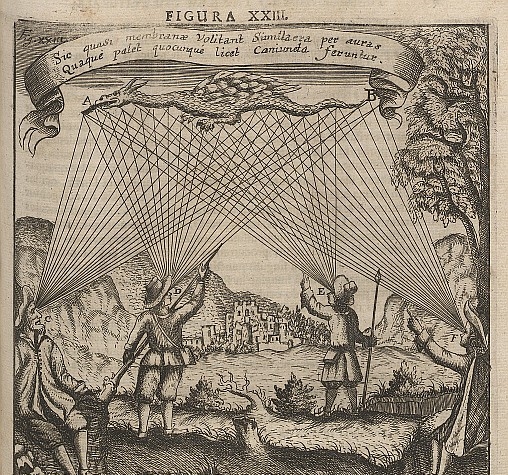
ReligionForBreakfast refers to extramission as a “haptic” theory of vision, in that looking upon something is literally reaching out and physically interacting with the thing. The subject’s gaze “touches” the object. This theory is brought up in the video by way of explanation for why ancient belief in the evil eye (or similar phenomena) was reasonable and consistent with their overall worldview. Nowadays, the evil eye is considered a superstition and the idea that looking upon a person with envy could curse them is considered paranormal.
I thought this particular connection was interesting, and I started doing research about the extramission theory of vision in connection with the evil eye. One of the first results I came across was a paper by Colin Ross, “Hypothesis: The Electrophysiological Basis of Evil Eye Belief.”
Abstract:
The sense of being stared at is the basis of evil eye beliefs, which are regarded as superstitions because the emission of any form of energy from the human eye has been rejected by Western science. However, brainwaves in the 1–40 Hertz, 1–10 microvolt range emitted through the eye can be detected using a high-impedance electrode housed inside electromagnetically insulated goggles. This signal, which the author calls ‘‘human ocular extramission,’’ is physiologically active and has distinct electrophysiological properties from simultaneous brainwave recordings over the forehead. Western science’s rejection of evil eye beliefs may be based on an erroneous rejection of a widespread component of human consciousness, the sense of being stared at, which may in turn be based on a real electrophysiological signal. The author proposes a series of future studies designed to determine whether human ocular extramission is the basis of evil eye beliefs.
Colin Ross (2010). “Hypothesis: The Electrophysiological Basis of Evil Eye Belief.” Anthropology of Consciousness, Vol. 21, Issue 1, p. 47
Ross is quick to clarify that he does not have an extramission theory of vision per se. He accepts the intromission theory which says that our everyday experience of vision is caused by photons entering the eye. What Ross is doing is positing a second, different phenomenon, in which the eyes emit electromagnetic radiation generated by electrochemical activity in the brain. This radiation is in the range of extremely low frequency radio waves.
… extramission and intromission need not be mutually exclusive models.
Colin Ross (2010). “Electrophysiological properties of human ocular extramission.” Subtle Energies & Energy Medicine, Vol. 21, Number 2, p. 22
Much of Ross’s writing on this involves the details of his methodology and data. I don’t know enough about this area to assess his work, but I have seen his understanding of electromagnetics criticized online. Instead, I want to set aside whether or not there is good empirical evidence for human ocular extramission and discuss the other aspects of it. One important part of Ross’s beliefs about extramission is that it is also detectable by humans (and possibly other animals), as implied by his evil eye hypothesis and other remarks. Essentially, Ross would like to establish human ocular extramission as the explanation for the feeling of being watched.
Geometric questions
If ocular extramission is simply brain waves incidentally leaving one’s head through the holes in one’s skull, then we would not expect it to be a focused beam. Least charitably, we could suppose that the EM rays cover our entire field of vision, which provides no explanation for the “feeling of being watched” phenomenon. Being very charitable we might suppose the the EM rays pass only through the pupil of the eye (which low frequency radio waves would have no reason to do). Even if the angle is extremely narrow, over long distances the waves would cover a large area. This would mean that even looking near a person could trigger the sensation of being looked at, which does not seem to be what Ross wants to argue. Maybe Ross would say that it doesn’t function over long distances. The evil eye generally does function over long distances in superstition, although that could be folklore expanding upon a real phenomenon. Rupert Sheldrake, one of the few other contemporary researchers to support the extramission theory, presents a variety of evidence that suggests a human’s stare can be detected at long distances, reflected in mirrors, and even over the internet. Even though Ross and Sheldrake agree on a controversial point that almost no one else agrees with, their theories are totally incompatible with each other.
See: Rupert Sheldrake (2005). “The Sense of Being Stared At: Part 1: Is it Real or Illusory?” Journal of Consciousness Studies. 12: 10-31
One problem with systematic false beliefs, like flat earth, conspiracy theories, religious fundamentalism, and the paranormal, is that they have a tendency to imitate legitimate systems of knowledge. By going into detail on something that is fictional, disagreements frequently arise, because people naturally make up different details. Since there is no external reference point in reality, there is no arbiter of truth, and so disagreements abound. In religion this problem may be solved by having an earthly representative (either a text or a person) serve as the authority. To be fair, such disagreement also occurs on the cutting edge of science. However, ocular extramission is no “dark matter of psychology.” It rests in the same category as other paranormal and psychic phenomena, having a great deal of anecdotal evidence but virtually no scientific evidence. Ross and Sheldrake’s theories are mutually exclusive, but even if some kind of phenomenon like this exists, they are probably still both wrong.
Evolutionary argument
Ross suggests that, if ocular extramission exists, then it could have been adaptive in predator-prey relationships for prey organisms to detect the remote gaze of a predator. This might seem reasonable at first, but let’s think about this. Ross’ predation hypothesis requires that the “signal” be unintentional and unpreventable on the part of the predator. Otherwise, it would have been adaptive for predators to conceal their gaze from their prey. The relationship between predator and prey is a desperate struggle, and frequently causes evolutionary arms races. A good analogy is owls and mice. As a bird glides through the air, the vibrations from the friction between their feathers and the air can be detected remotely by sensitive organs in a mouse’s head. (The purpose for describing hearing in this way is to draw the analogy to ocular extramission.) Mice evolved large, sensitive ears for effective predator detection. In order to keep up, owls evolved highly specialized wing feathers that dampen the sound of their flight almost completely. In an evolutionary arms race, adaptations evolve in tandem until some kind of equilibrium is achieved or the ecosystem is disrupted.
Humans may consider ourselves to be the top of the food chain now, but we have adaptations of both predator and prey. Our forward-facing eyes, canine teeth, digestive system, and so on all reflect our ancestral history as hunters. Some of our senses and fears, however, come from our ancestors adapting to the other animals that were a threat to them. There is evidence that our primate ancestors’ sense of vision evolved to quickly detect snakes specifically. This is one explanation for why it is so easy to mistake a stick on the path for a snake out of the corner of your eye, because your brain is hardwired to be sensitive to those stimuli.
See: Isbell, L. A. (2006). “Snakes as agents of evolutionary change in primate brains.” Journal of Human Evolution, 51(1), 1–35.
All of this raises a series of questions about Ross’s hypothesis. If we assume that human ocular extramission is real, humans can detect through some faculty that another human is looking at them, and ocular extramission is the explanation for this detection, then:
- Why did humans, as predatory animals, not evolve a way to conceal their gaze?
- Why did humans, as prey animals, not evolve a more sensitive and specialized organ for detecting another’s gaze?
One possible explanation is that this evolved very recently in humans, and has not had time to develop. However, this is inconsistent with Ross’ evolutionary hypothesis. He even implies that ocular extramission and its detection is shared by many mammals.
Ross does not attempt at any point to explain the mechanism by which a person could detect the extramitted brainwaves. This glosses over the fact that there is no known mechanism by which the brain could detect another brain’s brainwaves, the technology humans invented to do this is quite sophisticated, and nothing physically similar exists in the human body. Moreover, recall that the evil eye specifically had to do with envy, and Ross specifically mentioned predation and not gaze-detection in general. While he doesn’t say it, I think Ross’s theory requires some way of differentiating threatening and non-threatening stares. As it turns out, brain waves do carry information about emotional states, but it’s not so simple.
Traditional methods are used to extract features from a fixed group of the same EEG channels for all subjects. However, brain-behavior is sophisticated and changes from one person to another and from one emotional state to another. Moreover, extracted features are either computed from the whole sample of the EEG signal, which contains irrelevant information, or from an arbitrarily chosen portion of the sample and not necessarily the portion of the signal that corresponds to the emotional excitation instant. There is a growing need for additional steps, such as the identification of epochs, which are the instants at which excitation is maximum during the emotion, and the selection of electrodes that show significant variation in brain activity during emotional states, to accurately detect emotional states. Experiments show that the addition of these steps drastically improves the quality of features.
Gannouni, S., Aledaily, A., Belwafi, K. et al. (2021). “Emotion detection using electroencephalography signals and a zero-time windowing-based epoch estimation and relevant electrode identification.” Sci Rep 11, 7071.
To have even the most basic ability to differentiate between threatening and non-threatening stares on the basis of incoming brainwaves would require the brain to be processing this information, and no evidence of this has ever been observed. Lest we forget, there are many parts of this which may just be physiologically impossible, such as a sensory organ to detect brainwaves. (Note that this is not the same as the electroreceptors in animals such as sharks, which detect the presence of an electric field generated by a nearby animal in order to locate the animal. Sharks, by the way, do have a special organ for doing this that we know about and understand, unlike humans with gaze-detection.)
We do know that humans are very sensitive to being stared at when we know we are being stared at. There is a great deal of research on eye contact, nonverbal communication, surveillance, the Hawthorne effect, panopticons, and so on. It is reasonable to infer that our other senses are highly attuned to detecting a stare, just like they are highly attuned to detecting snakes. In both cases it leads to some false positives (the feeling of being watched when alone, being startled by a serpentine root) but generates enough true positives to create, in many people, the belief from their anecdotal experience that they can detect when they are being watched (in some paranormal way). But the ability of humans to detect a stare is not another sense in addition to our others, rather it is an attunement of all of our senses and of our attention.
Better explanations for the evil eye
While the evil eye has no definitive origin story, most research (as cited in ReligionForBreakfast’s video) suggests that fear of being envied had pro-social and economic benefits, and it was this more abstract fear of envy that eventually became the evil eye superstition. I recommend the video for the explanation, but I only mention it here to note that another hypothesis for the origin of the evil eye isn’t really necessary or called for. Ross has no new historical evidence, only the evidence regarding ocular extramission. As far as I can tell, anthropology is also outside his domain of expertise.
Things take a left turn
I noticed when doing research and coming across a paper by Ross that it was hosted on the website of something called “Ross Energy Systems.” I also noticed that Ross was not listed as being affiliated with an academic or medical institution, but rather something called “The Ross Institute,” with the Ross Institute having its own website listed as well. Upon further investigation, Ross is a curious character.
A goal of Ross Energy Systems is to develop technology that can detect and measure the eyebeam.
It turns out Ross owns a patent on goggles that detect human ocular extramission, and has this business that would, I guess, develop and manufacture this technology if there was any demand for it. This is a conflict of interest because he is trying to sell something that only works if his theory is correct, and his theory has not yet been accepted by the wider scientific community. That puts him in a position of profiting off of studies that confirm his theory and losing money if his theory is debunked. Ross also operates “The Colin A. Ross Research Foundation” which does not appear to do anything except owe The Ross Institute money, according to their tax records. The Research Foundation was established in 2012 and had no revenue until 2019, when they apparently made $1. They made another $1 in 2020.
“The Colin A. Ross Institute for Psychological Trauma,” to use its full title, is a private corporation founded in 1995. Ross works as a consultant for psychiatric programs, but The Ross Institute seems to also be Ross’s public face to large extent. The Ross Institute website is his main website regarding his clinical work and psychiatric research. Featured prominently on the home page are a number of Ross’s books, which are all published by a company called Manitou Communications. It turns out, Manitou Communications publishes Ross’s books almost exclusively, because it’s another of Ross’s companies. Any person who owns several extremely small companies and organizations, mostly named after them, is suspicious in my mind. Why couldn’t he get a normal publisher? Why did he make a separate company instead of publishing under The Ross Institute?
The books
Looking through his list of publications, the first few are what you would expect from a psychiatrist.
Treatment of Dissociative Identity Disorder.
Trauma Model Therapy.
Nothing unusual there. Ross’s specialization is in dissociative identity disorder and trauma. The first book that stands out is Shakespeare’s Tragedies and Other Poems, a somewhat confusingly named collection of poetry written by Ross about Shakespeare. Continuing down the list we find more books by Ross including some about CIA mind control, books about “human energy fields,” more collections of poetry, collections of essays, and a collection of plays described as “scripts for a proposed television series.” Three titles on the list stood out to me:
The Great Psychiatry Scam,
Pseudoscience in Biological Psychiatry: Blaming the Body,
and Satanic Ritual Abuse: Principles of Treatment.
Some of Ross’s books are just a little strange, like his books of poetry, some relate to his paranormal beliefs, which we’re somewhat familiar with from the eyebeams, some appear to be straightforward clinical books, there’s the CIA-related stuff (which I will discuss a bit later), and then there’s these three. The first two books listed above are related and I’ll discuss them first.
Antibiomedicalizationism
Ross belongs to a school of thought that is opposed to reductionism and scientism, or more precisely “biomedicalization,” in psychiatry. This general view is shared by some psychologists, philosophers, and members of the public. Within it, positions range from religion-based science denial, to antiestablishment conspiracy theories, to holistic alternative medicine, to intellectual criticisms of materialism, to analyses of modern medicine’s tendency to overlook social factors of illness.
See: Cohen, Carl I. (1993). “The Biomedicalization of Psychiatry: A Critical Overview.” Community Mental Health Journal, Vol. 29, No. 6, pp. 509-521.
Psychiatry is a relatively new field and its identity continues to change over time. “Modern” (western) psychiatry has only been developing for a couple hundred years. Starting around 1950, a series of discoveries in chemistry, biology, and physiology led to a “pharmacological turn” in psychotherapy. Since then, there have been many more discoveries in neurology, biochemistry, and chemical engineering, and the success of psychiatric medication has continued to grow. Now, psychopharmacological treatment of mental illness is almost ubiquitous.
There are a few problems with this situation. First, the pharmaceutical companies’ interests are not aligned with those of patients, and that alone warrants skepticism. “Big Pharma,” as it’s often called, has an interest in getting patients on medication, keeping patients on medication indefinitely, and especially putting patients on new medications when they are developed. In the US, pharmaceutical companies can advertise prescription drugs directly to patients, despite the fact that patients can’t buy them, in addition to advertising to doctors in various ways. This isn’t necessarily more sinister than other advertisement. It doesn’t imply that the drug is ineffective or has any problem with it, nor does it imply that the people at the company don’t stand by their product. The problem is that it’s impossible to tell the difference from an ordinary person’s perspective. No company should be trusted at their word 100% of the time, but neither are these companies universally evil. The reality of the situation is more complicated and unclear.
The second problem is that overprescription of medication is known empirically to be an ongoing issue across medicine. This is related to other issues, including the opioid epidemic and the growth of antibiotic resistant bacteria. Even if medication is capable of virtual miracles, it is undeniable that when overprescribed or misprescribed it will become harmful. A widespread concern I have heard is children are (or have been) medicated just for behaving like ordinary children around adults who can’t tolerate children’s behavior. This primarily concerns ADD/ADHD (now just called ADHD) and especially the drug Ritalin within the popular consciousness. However, a 2007 study suggests that the overdiagnosis and overmedication of ADHD is a misconception.
Increased medication use may reflect increased awareness of the disorder, improved access to resources, or a legitimate rise in incidence.
Mark J. Sciutto and Miriam Eisenberg (2007). “Evaluating the Evidence For and Against the Overdiagnosis of ADHD.” Journal of Attention Disorders, Volume 11 Number 2, p. 111.
There is an important distinction to be made between people who believe psychotropic medication is overprescribed and those who believe mental disorders do not exist at all. I’m ignoring the latter category since really my goal is to characterize Ross’ intellectual bedfellows. Scott O. Lilienfeld et al. suggest some reasons for why many clinical psychologists resist the scientific method. One is belief in naive realism:
Naïve realism, also called common sense realism or direct realism, is the erroneous belief that the external world is exactly as we see it. This belief is deeply embedded in our intuitions.
Scott O. Lilienfeld et al. (2013). “Why many clinical psychologists are resistant to evidence-based practice: Root causes and constructive remedies.” Clinical Psychology Review, Volume 33, Issue 7, p. 888.
Another reason given is incorrect beliefs about memory and how memory functions, especially repressed memories. That turns out to apply to Ross directly.
Satanic Ritual Abuse (SRA)
The third of those books I listed was Ross’s book on SRA. Recall that Ross’s specialization as a clinician is in dissociative identity disorder or DID (formerly called multiple personality disorder or MPD) and trauma. Satanic Ritual Abuse: Principles of Treatment was published in 1995, at the tail end of the “Satanic Panic” that overtook the US in the 1980s. DID/MPD was explicitly associated with SRA and the Satanic Panic. Therapists like Ross supposedly helped patients regain repressed memories of trauma, which they supposedly could not remember due to dissociating as a coping mechanism (Ross might have characterized it at the time as creating a separate personality).
See: Van Benschoten, S. C. (1990). “Multiple personality disorder and satanic ritual abuse: The issue of credibility.” Dissociation: Progress in the Dissociative Disorders, 3(1), 22–30.
See: Mulhern, S. (1994). “Satanism, Ritual Abuse, and Multiple Personality Disorder: A Sociohistorical Perspective.” International Journal of Clinical and Experimental Hypnosis, 42(4), 265–288.
Evidence of SRA never emerged, despite thousands of accusations and many court cases. Despite the “panic,” which was primarily within the media and public consciousness, there were many psychiatrists and others who were immediately skeptical of SRA reports.
It seems likely that Ross was one of the major perpetrators of false SRA memories based on what else I have learned. During my research I came across a forum thread from over a decade ago on internationalskeptics.com. It was about Ross. He had come to their attention after attempting the One Million Dollar Paranormal Challenge, an offer by the James Randi Educational Foundation (JREF) to pay out $1 million to anyone who could demonstrate a paranormal ability under scientific conditions. His entry was his eyebeam detecting goggles, but he and JREF were unable to agree on criteria for a proper scientific test. Anyway, during this time Ross himself joined the internationalskeptics.com forums to advertise his entry. A user on the forum happened to be a former patient of Ross, and one who had taken legal action against him. She posted a link to an article in which she was interviewed and exposed Ross’s wrongdoing.
According to one expert witness, it was the worst case of medical malpractice he had ever seen. The patient, Ms. Roma E. Hart, had been grossly over-medicated into a prolonged state of deranged confusion, during which time the offending psychiatrist, Dr. Colin A. Ross, had instilled her with exotic and perverse delusions: To wit, the rather implausible belief that her family was involved in an occult crime-ring dedicated to a supernatural evil, and that Hart herself had been forcibly impregnated by extraterrestrials, birthing a hybrid infant (presumably in the course of a routine alien abduction). The magnitude of Ms. Hart’s mistreatment during her submission to psychiatric “care” brought her to the precipice of death on several occasions.
Douglas Mesner (2010). “Real-Life United States of Tara Doctor, Dr. Colin Ross: Alleged Malpractice.” Boston Underground Examiner.
The proliferation of false repressed memories of abuse has destroyed many reputations and relationships irreparably. As we saw in the 1980s, it can spiral into a full blown moral panic. However, (false) accusations of abuse are a delicate issue. Historically, abuse (and especially sexual abuse of women and children) has been underreported and underprosecuted. “False memories” can easily be weaponized against victims by abusers and those who would downplay the impact of sexual abuse in society. It is still a good rule of thumb to trust the victim.
See: Dallam, S. J. (2001). “Crisis or Creation? A Systematic Examination of False Memory Syndrome.” Journal of Child Sexual Abuse, 9(3-4), 9–36.
It’s worth noting that modern QAnon-related conspiracy theories of satanism and pedophilia are continuations of the panic of the 80s.
Conspiracy theories
A person who believes in a conspiracy theory is likely to believe in multiple conspiracy theories. For some reason though, certain conspiracy theories seem to go together, even if fairly unrelated. The other major conspiracy theory that Ross believes in, which is apparently shared by other believers in SRA, is CIA mind control. Of course, it is now well known that the CIA performed mind control experiments and other experiments involving psychological warfare, parapsychology, and psychoactive drugs during the 20th century. The most well-know such experiment would be MKULTRA. The conspiracy is that the CIA succeeded in developing mind control.
The basic idea is using iatrogenic (clinically induced) DID/MPD to turn a neurotypical person into a “Manchurian Candidate” (this is literally the term Ross and others use). This means that the person has some instructions that they don’t remember, but when “activated” they will automatically follow the instructions. It was hoped that this would be an effective way of securing mission information from possible captors, and that it could be used to stage assassinations and the like. For example, Ross’s litigious former patient revealed that Ross believes children of military families are brainwashed and implanted with a second “personality,” apparently one of three Greek-letter-named options that would make the children do different things when activated, including commit suicide.
By the way, The Manchurian Candidate is a novel published in 1959 and adapted into film twice, in 1962 and in 2004. The plot involves an American soldier captured in the Korean War and sent to be brainwashed in communist China. The soldier is hypnotized so that he will assassinate a target when activated. Ross explicitly argues in his 2006 book The C.I.A. Doctors: Human Rights Violations by American Psychiatrists that the Manchurian Candidate phenomenon is real. Unlike many conspiracy theorists, he does not seem to believe the CIA is evil:
If the West had not won the Cold War, I would likely have died in Gulag many years ago. The CIA and military intelligence agencies are owed a personal debt by me on this count.
Colin A. Ross (2006). The C.I.A. Doctors: Human Rights Violations by American Psychiatrists, acknowledgements
Indeed, his fear and hatred for communism is rather extreme. This is consistent with his fellow conspiracy theorists. When searching on Google Scholar I noticed that an article by Ross was being hosted at the site usa-anti-communist.com. This is a fascinating website. It reads like a more coherent Time Cube in many ways. The author is highly focused on locating the Missing Crown of Liechtenstein, which has been missing since 1781, among several other conspiracy theories.

The author claims to have been brainwashed by communists using “MKULTRA technology,” has several blog posts about “Evil Bank Gremlins,” believes the NSA has been infiltrated by Satanists, believes in a global communist conspiracy to establish a New World Order (NWO), and claims to have been specially designated by Ronald Reagan to carry out this anti-communist mission. The author also warns that after the NWO has been established, there will be a genocide of US citizens. There is a running undercurrent of Germanic ethnonationalism throughout the author’s commentary. The website has a lot of content, most of it rambling text, but covers many topics. One singular page contains over 17,000 words alleging stalking and psychological harassment.

The National Security Agency has been infiltrated by Devil Worshipers known to be working long range takeover plans that span several generations. Long range Satanic takeover of the United States is in progress, and those Devil Worshipers are known to be planning to use Brainwave Frequency Following Response Microwave Mind Control on the entire population.
usa-anti-communist.com
Now, I am not suggesting Ross endorses anything on this site. I’m mostly just following this wherever it leads. In fact, Ross’s article which was hosted on usa-anti-communist.com was a copy from a page of the site wanttoknow.info. It looks like the article was originally written for that site, indicating that Ross has at least some association (if not endorsement of any kind) of this other site. Wanttoknow.info is also a conspiracy site, but one with much higher production value. They have many different contributors and claim to have thousands of subscribers. The navigation bar on the site reads as follows:
Home
Key Info
News
9/11
Banking
Health
Media
Inspiration
Elections
Energy
Mind Control
War
More
That “Energy” section includes information about free energy devices, which is a whole other can of worms, not to even mention the “9/11” section. The site also has categories for UFOs and the JFK assassination.
What’s the point?
Colin Ross and his associates are respected, working psychiatrists and clinical psychologists. Ross is anti-science, although his recent work on human ocular extramission has a strong façade of “hard science.” I find it strange that Ross is doing this stuff with eyebeams that seems very disconnected from his previous work. While it comes across as profiteering and could be unethical from that standpoint, it’s probably nowhere near as harmful as his work on DID/MPD.
Note that DID is a trauma-related condition. The Ross Institute is nominatively for “psychological trauma.” Glaringly absent from any discussion of this so far, however, is any mention of Post-Traumatic Stress Disorder (PTSD). Unlike DID/MPD (particularly under Ross’ conception), where trauma cannot be recalled due to memory repression, people with PTSD relive their memories of trauma unwillingly through flashbacks. It is possible that repression and flashbacks are just two different possible ways brains can respond to trauma. However, PTSD is commonly observed in those whose trauma demonstrably happened, whereas I could not find any examples at all in which a person was known to have experienced trauma prior to DID/MPD being recognized and diagnosed. PTSD also differs in that it has a direct connection to the traumatic event in most cases. Patients identified as having DID/MPD are thought to have a condition that specifically disconnected their experience from their past trauma. In other words, PTSD is easily observable and it is easy to tell when PTSD is related to abuse. It’s much more difficult to infer from observation that a person has DID and that it sprang specifically from childhood abuse. Moreover, SRA is associated with DID/MPD and not with PTSD; during the 1980s and 1990s, there were not large numbers of patients with PTSD reporting SRA.
Some in the psychiatric community are skeptical of the legitimacy of DID as a diagnosis at all. The name change in 1994 reflected an understanding that people never have separate, fully formed personalities. The modern description is more of a “fracturing.” Still, there is no precise empirical test for DID and there is no single agreed upon definition of “dissociation” in the literature. There is strong evidence that, even if DID or something like it does exist as a legitimate disorder, there are serious problems with our current ability to diagnose and treat it.
See: Piper, A., & Merskey, H. (2004). The Persistence of Folly: Critical Examination of Dissociative Identity Disorder. Part II. The Defence and Decline of Multiple Personality or Dissociative Identity Disorder. The Canadian Journal of Psychiatry, 49(10), 678–683.
There has been some research recently into the differences between the brains of people with and without DID, but this is still at the very early stages. Some differences have been observed, but no clear patterns or biological mechanisms have been identified.
See: Blihar, D., Delgado, E., Buryak, M., Gonzalez, M., & Waechter, R. (2020). A systematic review of the neuroanatomy of dissociative identity disorder. European Journal of Trauma & Dissociation
By the way, both of the papers I just mentioned cite Ross as an expert on DID. Not that they shouldn’t, of course, he is in fact an expert on DID/MPD and the way it is diagnosed and treated. Rather, the fact that such papers rightfully cite Ross is an indictment of the legitimacy of DID itself. This leading expert believes not only in the evil eye(beams), but also conspiracies about Satanism and CIA mind control. Now, I don’t mean to imply that Ross is such an important figure that this is an issue in itself. What worries me is that this is just one random example of something that happens all the time. When you see a person’s name cited in a paper, or read a paper they wrote, or look at the information on their website, you don’t get a complete picture of that person’s worldview or history. People with outlandish, dangerous false beliefs are all over the place, and they include people who are well-respected and who have access to vulnerable members of society. This is part of why I think conspiracy theories, superstition, creationism, flat earth, etc. should not be ignored. I get the impression that the number of people who believe things like this, and how prominent they are within society and institutions, is underestimated by the general educated public. People are perhaps more wary after many had personal experiences with QAnon followers, but the media frenzy around that has subsided and I am concerned that many people are returning to complacency. Magical thinking (a way of making incorrect causal inferences) and apophenia (a tendency to see patterns and connections where there are none) are dangerous and easily exploitable by liars.
What I find possibly even more problematic is how Ross and his ilk muddy the waters (or even unintentionally “poison the well”) when it comes to real issues like trusting victim testimony and criticizing the scientific method as implemented in psychiatry. Proliferation of false accusations makes courts, healthcare providers, and the general public less likely to believe accusations of abuse in general. Radical opposition to psychopharmacotherapy puts me and others in a position of defending it, which makes it more difficult to discuss the legitimate criticisms of this approach. Likewise, conspiracy theories about the CIA tend to reduce the focus on the real things the CIA and other government agencies have done and are doing. For example, Ross likes to bring up the Tuskegee Syphilis Study when talking about CIA mind control. Creating an association between this real historical event and modern conspiracy theories may make people take the Tuskegee Syphilis Study less seriously, or people might start to interpret mentioning the study as a red flag for conspiracy theorists.
 thoughts on mind